
Copley Scientific Introduces Improved Test Set-up for More Representative Inhaled Product Testing
The desire to gain a better understanding of how inhaled products perform in patients has highlighted the importance and value of achieving better correlations between in vitro test data and in vivo performance — better IVIVCs. This deepened interest has been echoed by FDA; for example, through research grants supporting the identification of realistic in vitro clinically relevant representations of the human throat, as well as a dissolution method for inhaled product testing.
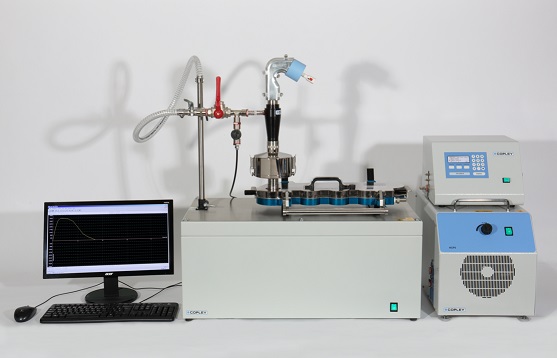
To help meet this pressing need for better IVIVCs, Copley Scientific has refined the design of a number of pieces of in vitro testing equipment to enable a streamlined, easy-to-use, and compact test set-up for more clinically representative testing of orally inhaled products (OIPs). The proposed set-up uses new components alongside established equipment to deliver data that represent in vivo behaviour more accurately than data from standard test methodologies, originally designed for application in a QC environment.
Achieving closer correlation between routine laboratory data and the efficiency of drug delivery to specific regions of the lung is an important goal in inhaled product testing. Better IVIVCs support the advancement of new OIP products and technology. They also underpin the secure demonstration of bioequivalence, a critical step in the development of generic OIPs and help reduce the risk of unexpected outcomes in clinical trials.
The proposed new test set-up from Copley Scientific includes the Alberta Idealized Throat (AIT) and the BRS 3000 Breathing Simulator. Adult and child versions of the AIT have a standardised geometry that has been shown to more representatively reflect deposition in the throat than the standard USP induction port used in routine OIP testing. A breathing simulator similarly supports the application of test conditions that are closely matched to the physiology and capabilities of a target patient group.
Related News
-

News Pharmaceutical Supply Chain People Moves
The latest appointments, promotions, and structural changes across the pharmaceutical supply chain.
-

News Merck KGaA to buy US biotech SpringWorks for US$3.9 billion
The German multinational pharmaceutical company Merck KGaA have signed a deal to buy US biotech company SpringWorks Therapeutics at an equity value of US$3.9 billion in a move to add rare cancer therapeutics to their pipelines.
-

News Cassava Sciences halts Alzheimer's drug trial after limited progress
Cassava Sciences have drawn a close to their investigations and development of the drug simufilam, which they intended to be used for the treatment of Alzheimer’s disease.
-

News US FDA adds haemodialysis bloodlines to devices shortage list
On March 14, 2025, the US FDA published an open letter to healthcare providers citing continuing supply disruptions of haemodialysis bloodlines, an essential component of dialysis machines.
-

News Vertex Pharmaceuticals stock jumps as FDA approves non-opioid painkiller
UK-based Vertex Pharmaceuticals saw their stock shares soar as the US FDA signed off on the non-opioid painkiller Journavx, also known as suzetrigine, for patients with moderate to severe acute pain, caused by surgery, accidents, or injuries.
-

News Lessons from CPHI Milan 2024: Sunny Intervals for Pharma Manufacturing?
As the 2024 CPHI conference wrapped up in Milan, we caught up with L.E.K. Consulting – a global strategy consulting firm with deep expertise in pharma manufacturing – to discuss evolving market perspectives and business outlook. -

News US BIOSECURE Act passed by US House of Representatives
The controversial act, which has already impacted several foreign companies operating in the US, was passed by the House of Representatives on September 9, 2024. It is now headed for the US Senate before it can be signed into law by President Joe Biden... -
News Drug prices agreed upon as part of the US Inflation Reduction Act
The Inflation Reduction Act brought into constitution by the Biden administation in 2022, which proposed a drug price negotiation between the government and pharmaceutical companies, has reached it's first agreement.