
Copley Scientific introduces new, upgraded breath simulators for inhaled product testing
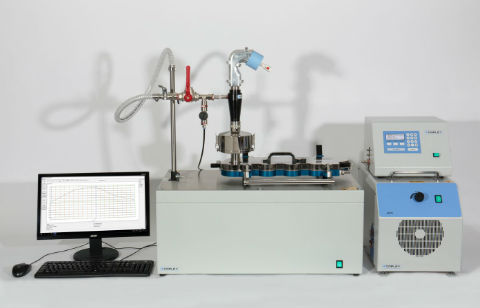
a test set-up optimised for improved IVIVCs, incorporating the BRS3100 and the adult Alberta Idealised Throat.
The upgraded BRS simulators make it even easier to apply specified inhalation profiles during OIP testing.
Copley Scientific has launched new, advanced breath simulators - the BRS 2100 and BRS 3100, for orally inhaled product (OIP) development and testing. In recent years, in response to regulatory and pharmacopoeial changes, and the drive to ensure closer correlation between in vivo and in vitro performance, scientists have increasingly incorporated breath simulators into their testing methods. Now, the upgraded BRS simulators from Copley Scientific make it even easier to apply specified inhalation profiles during OIP testing.
The BRS 2100 is ideally configured for testing nebulisers and metered dose inhalers (MDIs) with spacers/valved holding chambers (VHC) in accordance with US Pharmacopeia Chapter <1601> and Chapter <1602> respectively; the latter having only recently been released. The BRS 2100 has a maximum volume of 900 mL making it ideally suited to the low-volume, tidal breathing applications required by these chapters. The BRS 3100 offers greater volumes (500 mL up to 5000 mL) and the increased power (maximum flow rate of 240 L/min) needed for generating profiles typical of patients using MDIs and dry powder inhalers (DPIs) under forced inhalation conditions, helping to improve in vitro-in vivo correlations (IVIVCs).
As well as generating the ‘standard’ breathing profiles needed to measure delivered dose uniformity (DDU) according to pharmacopoeial requirements, namely: neonate, infant, child, and adult, for nebulisers and MDIs with spacers/VHCs, both the BRS 2100 and 3100 are designed to generate user-defined, patient-derived breathing profiles that more closely mimic real-world clinical situations. Importantly, the standard profiles can be used as a base and edited for development studies, adjusting the selected square, sinusoidal or triangular pattern, the tidal volume and the number, duration and timing of each breathing cycle, for example. For even more control, users can build and then save their own unique breathing profiles to simulate any desired pattern or breathing technique, as may have been recorded in clinic. Both breath simulators can be used for DDU applications or combined with a cascade impactor, using a mixing inlet, for aerodynamic particle size distribution (APSD) studies under more patient realistic conditions.
Compared with prior BRS 2000 and 3000 models, the BRS 2100 and BRS 3100 both feature an upgraded Quad-Core processor, increased RAM, improved Windows 10 operating system, and redesigned software, as part of the embedded, on-board computer. Significant gains in data processing speed and usability are the result. The instruments are also more flexible; for example, flow rates can be displayed in mL/s or L/min, and it is now easier to simulate uncoordinated product use, in the case of VHCs, by synchronising sampling with the exhalation portion of a breathing profile. In addition, the mechanics have been advanced – with improved motor, piston and cylinder performance enabling the more rigorous testing of high-resistance inhalers, and the creation of more powerful inhalation profiles. Additional peripherals and external data transfer are improved by the increased number of USB ports.
Mark Copley, Sales Director at Copley Scientific, comments: “In recent years, breath simulators have become a core piece of OIP testing equipment. This is partly because of the need to achieve better in vitro-in vivo relationships to enhance product development, and also in response to changing regulatory guidance, which has been updated for greater clinical relevance. Significant progress was made when the previous generation of breath simulators was introduced and now, with our upgraded series of instruments, we are very pleased to be putting state-of-the-art tools once again into the hands of our users.”
Related News
-

News Pharmaceutical Supply Chain People Moves
The latest appointments, promotions, and structural changes across the pharmaceutical supply chain.
-

News Merck KGaA to buy US biotech SpringWorks for US$3.9 billion
The German multinational pharmaceutical company Merck KGaA have signed a deal to buy US biotech company SpringWorks Therapeutics at an equity value of US$3.9 billion in a move to add rare cancer therapeutics to their pipelines.
-

News Cassava Sciences halts Alzheimer's drug trial after limited progress
Cassava Sciences have drawn a close to their investigations and development of the drug simufilam, which they intended to be used for the treatment of Alzheimer’s disease.
-
News US FDA adds haemodialysis bloodlines to devices shortage list
On March 14, 2025, the US FDA published an open letter to healthcare providers citing continuing supply disruptions of haemodialysis bloodlines, an essential component of dialysis machines.
-

News Vertex Pharmaceuticals stock jumps as FDA approves non-opioid painkiller
UK-based Vertex Pharmaceuticals saw their stock shares soar as the US FDA signed off on the non-opioid painkiller Journavx, also known as suzetrigine, for patients with moderate to severe acute pain, caused by surgery, accidents, or injuries.
-

News Lessons from CPHI Milan 2024: Sunny Intervals for Pharma Manufacturing?
As the 2024 CPHI conference wrapped up in Milan, we caught up with L.E.K. Consulting – a global strategy consulting firm with deep expertise in pharma manufacturing – to discuss evolving market perspectives and business outlook. -

News US BIOSECURE Act passed by US House of Representatives
The controversial act, which has already impacted several foreign companies operating in the US, was passed by the House of Representatives on September 9, 2024. It is now headed for the US Senate before it can be signed into law by President Joe Biden... -
News Drug prices agreed upon as part of the US Inflation Reduction Act
The Inflation Reduction Act brought into constitution by the Biden administation in 2022, which proposed a drug price negotiation between the government and pharmaceutical companies, has reached it's first agreement.