Making potent API milling safe, simple, and flexible.
API Micronization | Case study
Recently, FPS Pharma was approached by a pharmaceutical manufacturer seeking a milling solution to micronize a portfolio of highly potent compounds within a confined production space. The objective was to build a precise understanding of the customer’s operational needs and health risks, and to engineer a solution that simultaneously protects operators, the environment, and the product with no compromise on efficiency of the process and ergonomics.
Recently, FPS Pharma was approached by a pharmaceutical manufacturer seeking a milling solution to micronize a portfolio of highly potent compounds within a confined production space. Because the compounds exhibited different physicochemical properties and processing behaviors, it was clear that the customer required a custom multi-milling station integrated within a high-containment isolator. In this scenario, the FPS Pharma engineers began with a comprehensive technical and risk evaluation. This analysis included: the OEB level of the most potent compound, target PSD specifications, maximum dust potential, standard operating procedures (SOPs), time-weighted average exposure limits, the customer’s overall process and plant, and space constraints.
The objective was to build a precise understanding of the customer’s operational needs and health risks, and to engineer a solution that simultaneously protects operators, the environment, and the product with no compromise on efficiency of the process and ergonomics.
How to identify the proper milling technologies?
To define the most suitable milling systems to be integrated into the isolator, we leveraged the extensive expertise and testing experience of our micronization specialists and scientists at FPS Pharma’s Micronization Excellence Centre. This enabled us to identify the milling technologies required to achieve specific granulometries—depending on the compound type and the PSD targeted at each milling phase—as well as the critical parameters and optimal set-up for each mill. With these test results and all relevant data at hand, our engineers designed a solution that not only ensured the customer’s specifications were met but exceeded expectations.
Taking into account the various milling processes and the limited available space for equipment installation, we proposed a custom multi-milling station designed to allow easy mounting and dismantling of the required mechanical and jet mills (both spiral and loop mills). This approach optimizes the use of internal chamber space and enables the customer to switch between milling technologies depending on the specific compounds being processed. This led to the final multimilling station, which included the following mills:
1 conical mill1 hammer mill1 pin mill1 loop mill1 spiral jet mill
This platform ensures achievement of target PSDs across compounds, full micronization flexibility, and fast, safe cleaning, maintenance, and inspection operations.
High-containment isolator design
Our Engineering Department then developed the compact high-containment isolator engineered to achieve a Containment Performance Target (CPT) down to 10 ng/m³, ensuring seamless integration into existing production environments. The system is designed for smooth operation, superior ergonomics, and full compliance with applicable EU directives and international standards, including the Machinery Directive, EMC and Low Voltage Directives, ISO 10648-2, ISO 14644-7, and EU GMP requirements.
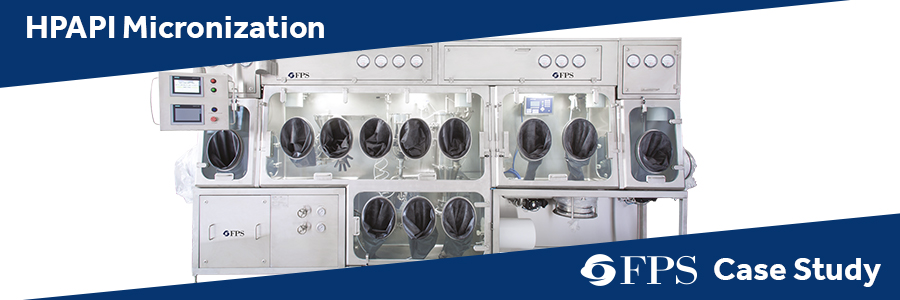
This OEB 6 containment isolator for pharmaceutical milling and micronization operates under negative pressure with turbulent airflow and is mounted on a robust supporting structure with adjustable leveling feet. The integrated containment solution includes an Airlock IN chamber, milling chamber, dispensing, and Airlock OUT chamber, ensuring controlled material flow and maximum operator protection. This configuration ensures controlled material flow and maximum operator protection.
In fact, materials and tools are safely introduced through the Airlock IN chamber, equipped with a BIBO system for contamination-free transfer. CIP and WIP systems enable efficient and validated cleaning, significantly reducing downtime during product changeovers. The chamber bottom is designed to direct residual cleaning liquids to a dedicated drain point, ensuring complete and easy liquid removal.
The milling chamber is connected to the Airlock OUT chamber via a custom stainless-steel door, sealed with an inflatable EPDM gasket and monitored by a proximity sensor for secure operation. A continuous liner system provides an additional containment layer for powder discharge and can be easily removed when not required. A continuous liner system is installed on the internal door toward the Airlock OUT chamber. The continuous liner door is sealed by a static EPDM gasket and mounted on a tri-clamp connection, allowing easy removal when not required. Sophisticated sensors and control systems continuously monitor ventilation performance, internal pressure, and door/port/window positions to ensure air quality, product quality, and operator safety.
Engineered Around People, Safety, and Results. Every design choice, every test, and every workflow is built around people, safety, and measurable outcomes. FPS Pharma’s success is silent. You rarely hear our name in production plants, because our solutions simply work.