
Seward Stomacher used for Hygiene Monitoring and Biosecurity
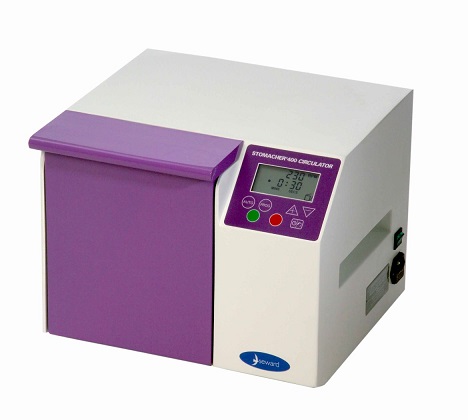
Seward Ltd, manufacturers of the world leading range of Stomacher paddle blenders and Stomacher accessories used in sample preparation for microbiological analyses, have highlighted the highly effective use of its Stomacher technology in combination with sponge swabs for hygiene monitoring and biosecurity applications.
Hygiene monitoring in food and pharmaceutical production facilities and clinical environments requires simple sampling techniques with excellent microbial recovery rates across a spectrum of different species. A recent study [1] has confirmed the effectiveness of the combined sponge swab and Stomacher sampling methodology for sampling a large surface area.
This popular sampling method utilises sponge swabs pre-dosed with buffer to swab a surface and then, to recover the micro flora, the sponge swabs are processed in the Stomacher 400 Circulator. A number of suppliers offer pre-manufactured devices such as 3M and Technical Services Consultants Ltd, which work very effectively in Stomacher products. Various different approaches can be applied, processing either pooled samples in the Stomacher® 400 or individual swabs in the Stomacher 80 Biomaster.
Due to the efficacy of the Stomacher and sponge swab combination, it has also been adopted in more critical fields such as biosecurity. Security services on both sides of the Atlantic have recently adopted the technique to detect and monitor the potential spread of weaponised bacterial contaminates such as Bacillus anthracis.
The effectiveness of the sponge and Stomacher technique over the swab technique for sample collection is demonstrated in a recent paper [1] concerning the clinical environment and the monitoring of Acinetobacter baumannii. The sponge and Stomacher technique allows for a greater surface area to be tested than achievable with a swab head. This also means that the sponge method delivers greater sensitivity.
Reference
1. K.A. Thom, et al., Comparison of swab and sponge methodologies for identification of Acinetobacter baumannii from the hospital environment. Journal of Clinical Microbiology 2012, 50(6):2140.
Related News
-

News Pharmaceutical Supply Chain People Moves
The latest appointments, promotions, and structural changes across the pharmaceutical supply chain.
-

News Merck KGaA to buy US biotech SpringWorks for US$3.9 billion
The German multinational pharmaceutical company Merck KGaA have signed a deal to buy US biotech company SpringWorks Therapeutics at an equity value of US$3.9 billion in a move to add rare cancer therapeutics to their pipelines.
-

News Cassava Sciences halts Alzheimer's drug trial after limited progress
Cassava Sciences have drawn a close to their investigations and development of the drug simufilam, which they intended to be used for the treatment of Alzheimer’s disease.
-
News US FDA adds haemodialysis bloodlines to devices shortage list
On March 14, 2025, the US FDA published an open letter to healthcare providers citing continuing supply disruptions of haemodialysis bloodlines, an essential component of dialysis machines.
-

News Vertex Pharmaceuticals stock jumps as FDA approves non-opioid painkiller
UK-based Vertex Pharmaceuticals saw their stock shares soar as the US FDA signed off on the non-opioid painkiller Journavx, also known as suzetrigine, for patients with moderate to severe acute pain, caused by surgery, accidents, or injuries.
-
News Lessons from CPHI Milan 2024: Sunny Intervals for Pharma Manufacturing?
As the 2024 CPHI conference wrapped up in Milan, we caught up with L.E.K. Consulting – a global strategy consulting firm with deep expertise in pharma manufacturing – to discuss evolving market perspectives and business outlook. -

News US BIOSECURE Act passed by US House of Representatives
The controversial act, which has already impacted several foreign companies operating in the US, was passed by the House of Representatives on September 9, 2024. It is now headed for the US Senate before it can be signed into law by President Joe Biden... -
News Drug prices agreed upon as part of the US Inflation Reduction Act
The Inflation Reduction Act brought into constitution by the Biden administation in 2022, which proposed a drug price negotiation between the government and pharmaceutical companies, has reached it's first agreement.