
Study finds 88% of pharma companies base global launch planning on regulatory affairs guidance
Various tools help drug companies establish successful global launch plans.
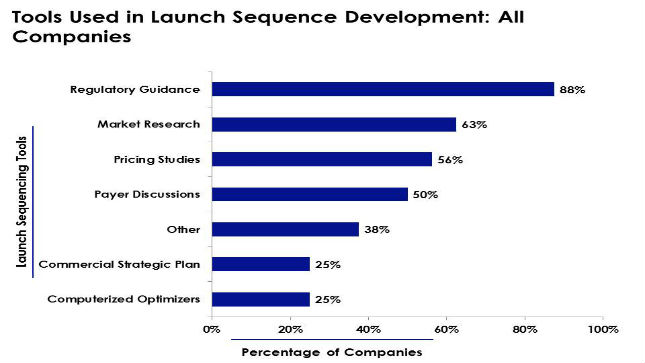
A new benchmarking study published by Cutting Edge Information has discovered that regulatory guidance is the most common tool that pharmaceutical companies use when developing their global launch strategies.
In fact, the majority, 88% of surveyed firms, look to regulatory guidance to inform global launch planning. Furthermore, 83% of large pharmaceutical companies and 80% of small pharmaceutical companies that participated in the study rely on regulatory guidance to establish a launch sequence. Regulatory guidance educates market access teams regarding potential requirements that companies may face when entering specific markets.
The study, Pharmaceutical Launch Sequencing: Establishing Patient Access and Understanding Global Pricing, researched the impact of various functional departments on launch sequence planning. For example, the study found that 63% of surveyed companies use market research to help their launch sequences. Surveyed drug companies used both in-house and outsourced market research to make decisions. Companies used other when developing launch sequences, such as pricing studies, payer discussions, commercial strategic plans, and computerized optimizers.
"Preparing a successful global launch is a challenge for any multinational drug company," said Adam Bianchi, senior director of research at Cutting Edge Information. "That's why it is important to use regulatory guidance and market research throughout the process."
Adequately staffed cross-functional boards are able to compile key commercial, regulatory and market access insights which influence these plans. Companies must also be able to resource these teams with adequate launch sequencing budgets and the tools necessary to make informed decisions.
Pharmaceutical Product Launch Sequencing: Maximizing Revenue and Achieving Global Market Access helps companies to maximize their margins when launching products around the world. The report identifies key trends in how companies approach launch sequences and what drives decision making among internal and external stakeholders. The report's key findings include
Related News
-

News Pharmaceutical Supply Chain People Moves
The latest appointments, promotions, and structural changes across the pharmaceutical supply chain.
-

News Merck KGaA to buy US biotech SpringWorks for US$3.9 billion
The German multinational pharmaceutical company Merck KGaA have signed a deal to buy US biotech company SpringWorks Therapeutics at an equity value of US$3.9 billion in a move to add rare cancer therapeutics to their pipelines.
-

News Cassava Sciences halts Alzheimer's drug trial after limited progress
Cassava Sciences have drawn a close to their investigations and development of the drug simufilam, which they intended to be used for the treatment of Alzheimer’s disease.
-

News US FDA adds haemodialysis bloodlines to devices shortage list
On March 14, 2025, the US FDA published an open letter to healthcare providers citing continuing supply disruptions of haemodialysis bloodlines, an essential component of dialysis machines.
-

News Vertex Pharmaceuticals stock jumps as FDA approves non-opioid painkiller
UK-based Vertex Pharmaceuticals saw their stock shares soar as the US FDA signed off on the non-opioid painkiller Journavx, also known as suzetrigine, for patients with moderate to severe acute pain, caused by surgery, accidents, or injuries.
-

News Lessons from CPHI Milan 2024: Sunny Intervals for Pharma Manufacturing?
As the 2024 CPHI conference wrapped up in Milan, we caught up with L.E.K. Consulting – a global strategy consulting firm with deep expertise in pharma manufacturing – to discuss evolving market perspectives and business outlook. -

News US BIOSECURE Act passed by US House of Representatives
The controversial act, which has already impacted several foreign companies operating in the US, was passed by the House of Representatives on September 9, 2024. It is now headed for the US Senate before it can be signed into law by President Joe Biden... -
News Drug prices agreed upon as part of the US Inflation Reduction Act
The Inflation Reduction Act brought into constitution by the Biden administation in 2022, which proposed a drug price negotiation between the government and pharmaceutical companies, has reached it's first agreement.