The force problem: Engineering springs for high-viscosity biologic delivery
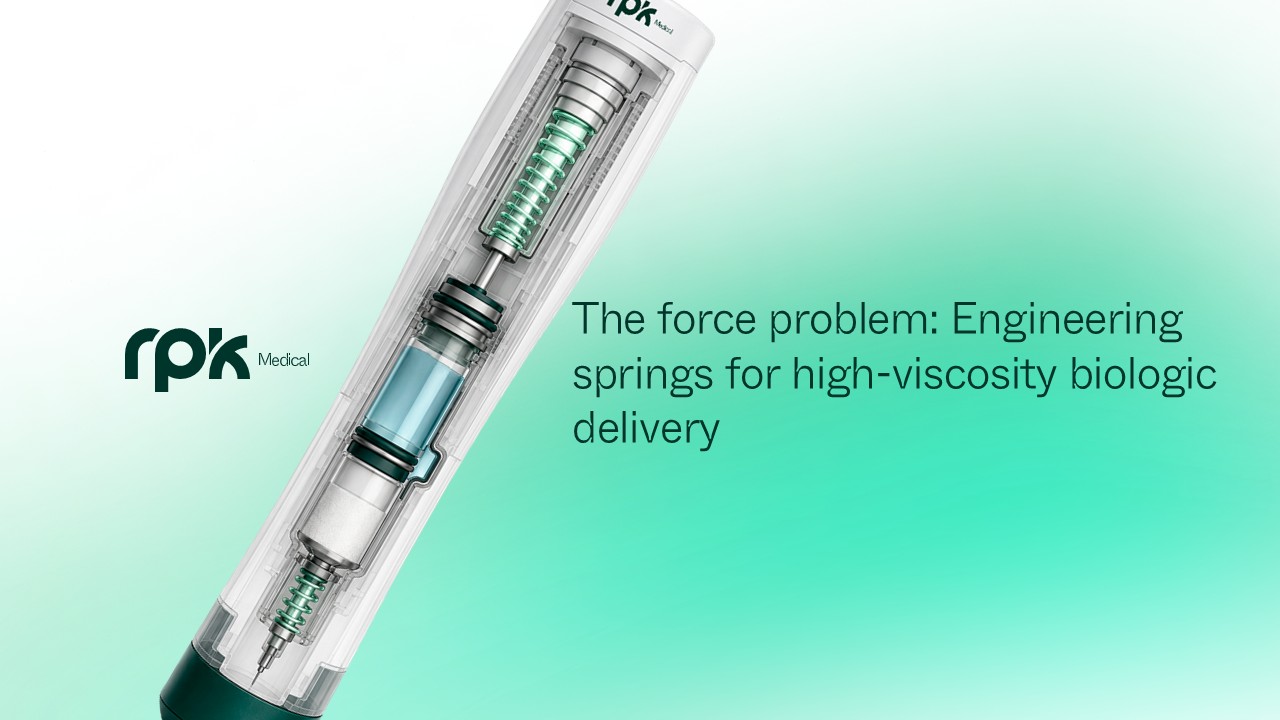
As biologics grow thicker and doses increase, the mechanism determines whether a device works. RPK Medical co-engineers that mechanism with device teams from the first design reviews
By Iker Ibisate and Álvaro García Nograro
Biologics are becoming thicker, and doses are increasing. Both trends converge on the same point: the delivery mechanism. A monoclonal antibody can now exceed 100 mg/mL, and the subcutaneous ceiling, which used to be around 1 to 2 mL per injection site, keeps getting pushed. When a drug can't be diluted, the volume increases. When the volume can't increase, the concentration rises. Either way, the mechanism has to move a thicker fluid on time without harming the patient or breaking the primary container. This is one of the hardest problems in drug delivery today, and it is a mechanical one.
Why do standard designs run out of room?
Viscosity and injection time pull in opposite directions. A device may target a 10- to 30-second injection, but a thicker fluid needs more force to move through the same needle in the same window. That force does not stay contained. It puts stress on the glass prefilled syringe, increases the risk of breakage, and is transmitted to the patient as pressure and pain. It also destabilizes dose accuracy because a spring tuned for water behaves differently when exposed to a concentrated biologic.
A high-force compression spring in 17-7PH stainless steel delivers speed, but speed is not the same as control. Push the volume higher, and the handheld format runs out of room entirely. Above roughly 2 mL, the injection becomes uncomfortable to hold, and the therapy switches to a wearable on-body system that requires the opposite behavior: lower flow, delivered slowly and steadily over minutes. The engineer is left balancing three variables that oppose one another — force, control, and comfort — within a shrinking envelope of space.
Solving it at the mechanism level
The answer is not one spring. It matches the spring architecture to the viscosity profile, volume, and delivery time, and does so before the tooling is cut. We work with the engineers developing these devices to size the mechanism against the real drug, not a nominal one.
- Telescopic and concentric springs stage the delivery, moving a viscous drug through controlled phases rather than a single hard push.
- Constant-force and power springs deliver a steady output over long durations, which on-body systems need to maintain flow stability to the last microliter.
- Integrated power packs combine springs and stamped components into a single assembly, ensuring a predictable force curve and a low part count.
- In a spring-constant simulation, the modeled load behavior is compared with measured displacement, so the injection speed is tuned to the viscosity profile before production.
- Part consolidation lets one precision metal strip serve as a spring, lock, and retention feature at once, freeing up space for miniaturized formats.
- EMI/ESD-safe conductive parts support the feedback and connectivity layer in smart, connected injectors.
Where the mechanism meets the trend
The same set of capabilities maps onto the device families shaping the field: high-force handheld autoinjectors for concentrated therapies in autoimmune disease, diabetes, and obesity; wearable on-body injectors for large-volume subcutaneous biologics in oncology and immunology; dual-chamber autoinjectors that reconstitute a lyophilized biologic at the point of use; and connected injectors that add feedback and data to the delivery event. Each removes a different bottleneck, and each depends on metal parts that behave exactly as designed.