
3-D Changes in DNA may Lead to a Genetic Form of Lou Gehrig’s Disease

New findings reveal how a mutation, a change in the genetic code that causes neurodegeneration, alters the shape of DNA, making cells more vulnerable to stress and more likely to die.
The particular mutation, in the C9orf72 gene, is the most common cause for amyotrophic lateral sclerosis (ALS, also known as Lou Gehrig’s disease), and frontotemporal degeneration (FTD), the second most common type of dementia in people under 65.
This research by Jiou Wang, PhD, and his colleagues at Johns Hopkins University (JHU) was published in Nature and was partially funded by the National Institutes of Health’s National Institute of Neurological Disorders and Stroke (NINDS).
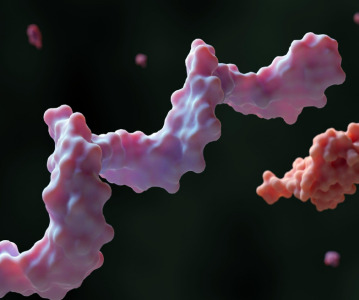
Using sophisticated molecular techniques, Dr Wang and his team showed that the mutation causes changes in the three-dimensional shape of DNA. DNA is normally shaped like a twisted ladder. However, the repeating sequences can fold into G-quadruplexes, stacks of square-shaped molecules known as G-quartets. "This structure has been described as a square building with each floor representing one G-quartet, normally two to four stories high,” said Dr Wang, senior author of the paper.
Their results also showed that C9orf72 mutated DNA has profound effects on how the genetic message is processed in the cell. RNA, short for ribonucleic acid, acts as an important intermediary — a middleman — in the process that converts genetic information from DNA into functional proteins. This happens in two stages: conversion of the DNA code into RNA is called transcription. RNA then forms proteins during a process known as translation.
To read NIH's full story, click here
Related News
-

News GSK announces £400 million investment in new Cambridge R&D centre
Pharmaceutical giant to establish flagship research facility on Cambridge Biomedical Campus as part of strategic pipeline acceleration
-

News Understanding the Benefits and Advances of Cleanroom Technology
In an industry where precision and sterility are crucial concerns, cleanrooms play a vital role in maintaining the integrity of pharmaceutical products like drugs, vaccines, and other medical products. So, what is a cleanroom?
-

News AbbVie secures GBP£1.2 billion deal for Gilgamesh’s psychedelic programme
AbbVie has penned a significant agreement to acquire the bretisilocin programme from Gilgamesh Pharmaceuticals for up to £1.2 billion, marking a bold step in the pharmaceutical giant's quest to develop treatments for psychiatric disorders. -

News Gates Foundation commits US$2.5 billion to women’s health research
The Bill & Melinda Gates Foundation has announced a substantial US$2.5 billion commitment to accelerate research and development focused exclusively on women's health through 2030.
-

News Mid-year review: notable FDA drug approvals of 2025
As we fly past the halfway point of 2025, the pharmaceutical landscape reliably continues to evolve with innovative therapies addressing critical medical needs. The FDA has already approved 17 groundbreaking medications this year, each representin... -

News US FDA announces new priority vouchers for accelerated review times
The US FDA announced a new priority program for drug developers – the Commissioner’s National Priority Voucher (CNPV) program aims to enhance the health interests of the US by allowing drug developers to redeem a voucher, shortening th... -
News Google-backed start-up raises US$600 million to support AI drug discovery and design
London-based Isomorphic Labs, an AI-driven drug design and development start-up backed by Google’s AI research lab DeepMind, has raised US$600 million in its first external funding round by Thrive Capital. The funding will provide further power t... -

News AstraZeneca to invest US$2.5 billion in Beijing R&D centre
Amid investigations of former AstraZeneca China head Leon Wang in 2024, AstraZeneca have outlined plans to establish its sixth global strategic R&D centre in China. Their aim is to further advance life sciences in China with major research and manufact...