
A powerful new tool for the separation of charged species
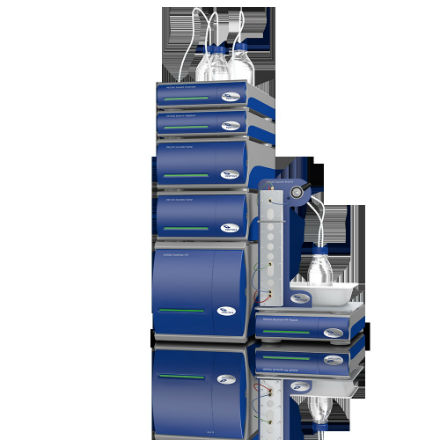
Postnova's new EAF4 system.
A new analytical tool, Electrical Asymmetrical Flow Field-Flow Fractionation (EAF4) is showing much promise in biopharmaceutical and nanoparticle applications.
Traditional separation technology in these fields provides particle size or molar mass distributions as the final result. It is clear, however, that particle and molecular charge plays a primary role in many applications such as protein aggregation, polymer flocculation, particle agglomeration and in pharmaceutical formulations in general.
The new Postnova EAF2000 instrument using EAF4 technology opens a completely new way to a significantly better understanding of these phenomena by allowing the particle size or molar mass distributions to be further differentiated and transformed into charge distributions. This allows identifying charge heterogeneities, which may be present within the different size and molar mass fractions and will quickly help to aid research or establish more efficient product development processes.
The EAF2000 instrument works by combining the principle of electrical and flow field-flow fractionation (FFF) in one experiment. In flow FFF the molecules and particles are gently separated in an open channel which avoids any interaction with column packing material keeping aggregation and structures intact. The electrical field, either positive or negative, can now be applied during this separation to differentiate between differently charged species of the same size or molecular weight.
The new Postnova EAF2000 technology is also designed in such a way that it allows the determination of the electrophoretic mobility (or zeta-potential) of the separated analytes under investigation. This is a key new tool, particularly for protein research as existing techniques for zeta-potential are limited by concentration and are simple batch techniques giving just an average value for all components in the solution. The new EAF2000 can determine the zeta-potential of each individually separated component such as protein monomer and dimer (or higher aggregates) or antibody monomer and fragments/aggregates.
Early successes with the technology have been found in applications as diverse as the separation of a positively charged pharmaceutical protein formulation, determination of the difference in zeta-potential of protein monomer and dimer and the differentiation of charge on polymer latex particles.
There is the first chance to see this technology in action on 6 March at the 2nd Postnova FFF Seminar at the company's UK headquarters in Malvern (UK). Following the popularity of the first Postnova first seminar, an informative program of talks from eminent guest speakers, plus presentations from Postnova scientists has been assembled.
The free 2018 seminar has been designed to advance the attendees knowledge of applications and techniques in nanoscale characterisation. The seminar will be particularly useful to those interested in using FFF, Size Exclusion Chromatography (SEC/GPC) and Light Scattering/Viscometry (MALS/DLS), as well as those interested in how these techniques may be useful in their research.
With limited attendee spaces available please register now for this free Seminar by contacting Postnova Analytics at [email protected].
Related News
-
News Novartis signs US$3.2 bn subcutaneous delivery deal with Alteogen
Swiss pharma giant secures access to Korean biotech's ALT-B4 hyaluronidase platform in milestone-heavy agreement, marking Alteogen's fourth major licensing deal of 2026 as competition intensifies in the subcutaneous drug delivery space.
-

News Women in Pharma: The philosophy of pharmaceutical leadership
In this latest instalment of our Women in Pharma series, we sit down with Clarissa Sowemimo-Coker, Chief Strategy Officer at Ambrose Healthcare and CPHI Middle East Advisory Board Member.
-

News The PSCI Supplier Partnership - Collaboration for Responsible Supply Chains
About the Pharmaceutical Supply Chain Initiative The Pharmaceutical Supply Chain Initiative (PSCI) is the leading, member-led association for pharmaceutical companies working collaboratively to build responsible supply chains. Founded in 2006 and es... -

News AstraZeneca shares plunge 8.9% after reports of BMS talks
Britain's largest drugmaker lost more than GBP£17 billion in market value following reports of preliminary merger discussions with Bristol Myers Squibb that could create a pharmaceutical giant worth nearly US$400 billion, though investors rem... -

News GSK announces £400 million investment in new Cambridge R&D centre
Pharmaceutical giant to establish flagship research facility on Cambridge Biomedical Campus as part of strategic pipeline acceleration
-

News The CPHI Sustainability Summit - Where Conversation Becomes Collaboration
The Report Was Never the Destination - “The future of pharmaceutical sustainability won’t be shaped by individual organisations working in isolation. It will be shaped by partnerships, shared expertise and the willingness to work diffe... -

News Trump's generic drug tariffs set to reshape global pharmaceutical supply chains
The US president has announced plans to impose tariffs of up to 200% on imported generic medicines from August 2028, giving manufacturers a two-year window to establish domestic production facilities. The move threatens to upend a global supply chain t... -

News Building Safer, More Responsible Pharmaceutical Supply Chains: PSCI Global Audit Insights
The Pharmaceutical Supply Chain Initiative (PSCI) has released its seventh annual Audit Findings Analysis Report, offering unprecedented insights into supplier practices across the global pharmaceutical and healthcare industry.With a record-breaking 24...