
A Snapshot of the NGS Market — User Views
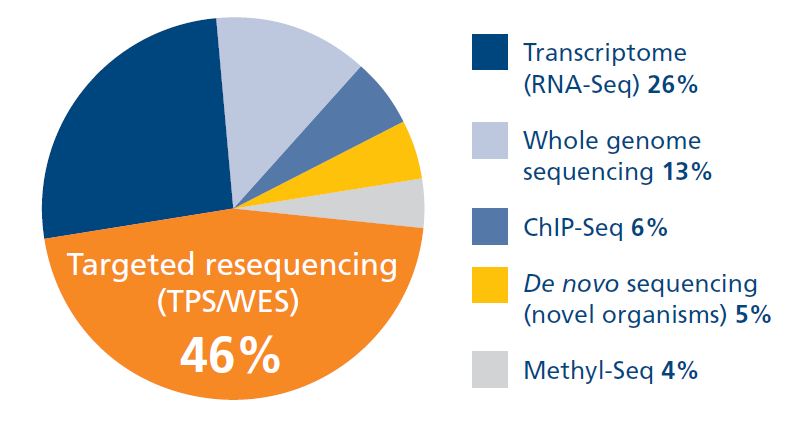
Oxford Gene Technology (OGT), provider of innovative genetics research and biomarker solutions to advance molecular medicine, has released the results from a recent survey of researchers using next generation sequencing (NGS). The survey was designed to investigate current trends in NGS usage and determine future demands; to aid OGT in continuing to deliver high-quality, up-to-date services and provide insightful, relevant customer resources. The company received 596 responses from its worldwide database of contacts and donated to the UK charity DEBRA (for the genetic skin blistering condition Epidermolysis Bullosa) for each completed survey.
Responses on the most popular research areas for NGS and choice of methods uncovered a trend towards cost-effective, high-resolution targeted resequencing techniques over whole genome sequencing, with the Illumina platform identified as the leading technology. Cancer and rare disease are the most popular research areas for using NGS, supporting the use of targeted approaches which enable more accurate detection of rare variants.
Challenges in bioinformatics were found to be one of the biggest barriers to NGS implementation, which may explain why over a third of investigators choose to outsource data analysis. Supporting this finding, data quality and bioinformatics expertise are cited in the top three essential factors when choosing an NGS service provider.
Further insights into the use of NGS for clinical tests, preferred NGS methods, and demands on service providers are also presented. Download the full results here.
The survey adds to a growing portfolio of informative resources from OGT on NGS, including a recent whitepaper on choosing the right NGS method and a free-to-download demo version of their innovative and easy to use Genefficiency NGS reporting software.
Related News
-

News Novartis signs US$3.2 bn subcutaneous delivery deal with Alteogen
Swiss pharma giant secures access to Korean biotech's ALT-B4 hyaluronidase platform in milestone-heavy agreement, marking Alteogen's fourth major licensing deal of 2026 as competition intensifies in the subcutaneous drug delivery space.
-

News Women in Pharma: The philosophy of pharmaceutical leadership
In this latest instalment of our Women in Pharma series, we sit down with Clarissa Sowemimo-Coker, Chief Strategy Officer at Ambrose Healthcare and CPHI Middle East Advisory Board Member.
-

News The PSCI Supplier Partnership - Collaboration for Responsible Supply Chains
About the Pharmaceutical Supply Chain Initiative The Pharmaceutical Supply Chain Initiative (PSCI) is the leading, member-led association for pharmaceutical companies working collaboratively to build responsible supply chains. Founded in 2006 and es... -

News AstraZeneca shares plunge 8.9% after reports of BMS talks
Britain's largest drugmaker lost more than GBP£17 billion in market value following reports of preliminary merger discussions with Bristol Myers Squibb that could create a pharmaceutical giant worth nearly US$400 billion, though investors rem... -

News GSK announces £400 million investment in new Cambridge R&D centre
Pharmaceutical giant to establish flagship research facility on Cambridge Biomedical Campus as part of strategic pipeline acceleration
-

News The CPHI Sustainability Summit - Where Conversation Becomes Collaboration
The Report Was Never the Destination - “The future of pharmaceutical sustainability won’t be shaped by individual organisations working in isolation. It will be shaped by partnerships, shared expertise and the willingness to work diffe... -

News Trump's generic drug tariffs set to reshape global pharmaceutical supply chains
The US president has announced plans to impose tariffs of up to 200% on imported generic medicines from August 2028, giving manufacturers a two-year window to establish domestic production facilities. The move threatens to upend a global supply chain t... -

News Building Safer, More Responsible Pharmaceutical Supply Chains: PSCI Global Audit Insights
The Pharmaceutical Supply Chain Initiative (PSCI) has released its seventh annual Audit Findings Analysis Report, offering unprecedented insights into supplier practices across the global pharmaceutical and healthcare industry.With a record-breaking 24...