
DynaPro Plate Reader Optimizes Screening Process for Biotherapeutic Candidates and Formulations
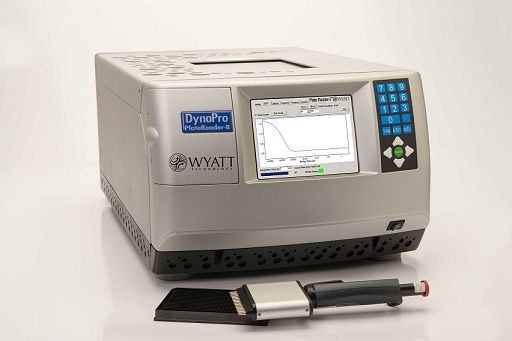
Wyatt Technology Corporation highlights a study recently authored by Martin Skov Neergaard from the Faculty of Health and Medical Sciences at the University of Copenhagen, “Protein-Protein Interactions Investigated by DLS: Determination at High and Low Protein Concentration.” This article outlines the benefits of quantifying protein-protein interactions (PPI) using automated dynamic light scattering (DLS) in high-throughput screening (HTS) mode to identify promising candidates for drug-like properties and establish the suitability of formulations before entering extended stability studies. The study, which used Wyatt Technology’s DynaPro Plate Reader II high-throughput DLS instrument, was published by GIT Laboratory and may be downloaded at www.wyatt.com/AppNotes/DLS.
Therapeutic monoclonal antibodies (mAbs) are effective at treating chronic diseases such as autoimmune disorders and cancer. Long-term stability is an important attribute of any commercial drug molecule, and of great interest in biotherapeutics in particular. Measurements of PPI indicate colloidal stability, correlate closely to stability and viscosity at high protein concentration, and are widely used as stability-indicating parameters (SIPs) in pre-selecting monoclonal antibody biotherapeutic molecules and formulation conditions before launching the arduous process of long-term stability testing. Ordinarily, PPI studies require significant quantities of sample and labor. Optimal screening processes of PPI will allow drug developers to identify and concentrate development on the most promising mAbs and formulations, saving considerable time and money while decreasing time-to-market.
The study showcases some novel uses of DLS to rapidly provide substantial information about the stability and viscosity of a formulation. Traditionally, PPI are quantified by static light scattering (SLS) as the second virial co-efficient (B22), though recently other techniques have come into widespread use. DLS has proven extremely useful in this field as it provides substantially more information regarding SIPs, with less sample, than standard SLS. DLS quantifies PPI via the diffusion interaction parameter (kD), and Neergaard also explored the relative radius method comparing apparent hydrodynamic radii at low and high concentrations. These methods, using kD and relative radius to quantify PPI in a protein solution, make the process of characterization much quicker and simpler than standard methods.
The DynaPro Plate Reader II is capable of running high-throughput, automated HTS-DLS analyses to characterize PPI in standard microwell plates, under multiple conditions in a significantly reduced time frame, making DLS a viable option for SIP screening. As an added benefit, DLS measures the viscosity of highly concentrated proteins with the same high throughput and low sample consumption. The onset points of aggregation or melting may be obtained in the DynaPro via temperature ramps or chemical denaturing, to assess additional SIPs for conformational stability, making the DynaPro DLS plate reader the ultimate tool for developability and formulation screening.
“Techniques for determining protein stability are still widely debated amongst researchers, and a combination of stability-indicating parameters must be weighed to get a complete picture,” explains Dr Daniel Some, Director of Marketing and Principal Scientist at Wyatt Technology, “Optimization of screening processes to reduce time and resources spent on ensuring long-term viability is a key consideration in the drug development process. The DynaPro Plate Reader II ensures comprehensive testing, over a range of conditions in minimal time, and eliminates the need for additional laboratory apparatus when screening the stability-indicating parameters of high concentration protein formulations.”
Related News
-
News Novartis signs US$3.2 bn subcutaneous delivery deal with Alteogen
Swiss pharma giant secures access to Korean biotech's ALT-B4 hyaluronidase platform in milestone-heavy agreement, marking Alteogen's fourth major licensing deal of 2026 as competition intensifies in the subcutaneous drug delivery space.
-

News Women in Pharma: The philosophy of pharmaceutical leadership
In this latest instalment of our Women in Pharma series, we sit down with Clarissa Sowemimo-Coker, Chief Strategy Officer at Ambrose Healthcare and CPHI Middle East Advisory Board Member.
-
News The PSCI Supplier Partnership - Collaboration for Responsible Supply Chains
About the Pharmaceutical Supply Chain Initiative The Pharmaceutical Supply Chain Initiative (PSCI) is the leading, member-led association for pharmaceutical companies working collaboratively to build responsible supply chains. Founded in 2006 and es... -

News AstraZeneca shares plunge 8.9% after reports of BMS talks
Britain's largest drugmaker lost more than GBP£17 billion in market value following reports of preliminary merger discussions with Bristol Myers Squibb that could create a pharmaceutical giant worth nearly US$400 billion, though investors rem... -

News GSK announces £400 million investment in new Cambridge R&D centre
Pharmaceutical giant to establish flagship research facility on Cambridge Biomedical Campus as part of strategic pipeline acceleration
-

News The CPHI Sustainability Summit - Where Conversation Becomes Collaboration
The Report Was Never the Destination - “The future of pharmaceutical sustainability won’t be shaped by individual organisations working in isolation. It will be shaped by partnerships, shared expertise and the willingness to work diffe... -

News Trump's generic drug tariffs set to reshape global pharmaceutical supply chains
The US president has announced plans to impose tariffs of up to 200% on imported generic medicines from August 2028, giving manufacturers a two-year window to establish domestic production facilities. The move threatens to upend a global supply chain t... -
News Building Safer, More Responsible Pharmaceutical Supply Chains: PSCI Global Audit Insights
The Pharmaceutical Supply Chain Initiative (PSCI) has released its seventh annual Audit Findings Analysis Report, offering unprecedented insights into supplier practices across the global pharmaceutical and healthcare industry.With a record-breaking 24...