Ferric Maltol of WBCIL: Optimized Absorption, Minimal Toxicity, And Sustainable Production for Chronic Iron Deficiency
Iron deficiency is the most common cause of anaemia globally. It is frequently reported in patients with underlying inflammatory conditions, such as inflammatory bowel disease (IBD) and chronic kidney disease (CKD). The treatment goals are to treat the underlying cause, limit further blood loss or malabsorption, avoid blood transfusions in haemodynamically stable patients, relieve symptoms, and improve quality of life [1]. Ferric maltol is a new oral iron replacement therapy designed to optimize iron absorption while reducing the gastrointestinal adverse events associated with unabsorbed free iron. Oral iron supplementation has been considered standard treatment because of its established safety profile, lower cost, and ease of administration [1]. Ferric maltol has been studied in clinical trials. It is approved for treating adults with iron deficiency with or without anaemia. It is well-tolerated over long-term treatment for up to 64 weeks; an important consideration in pati...
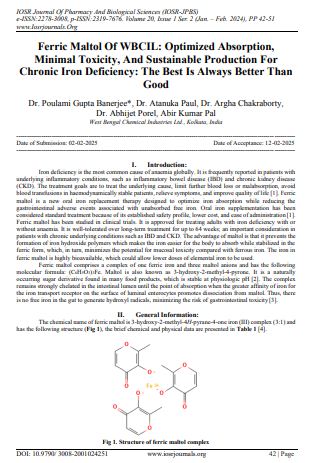
Iron deficiency is the most common cause of anaemia globally. It is frequently reported in patients with underlying inflammatory conditions, such as inflammatory bowel disease (IBD) and chronic kidney disease (CKD). The treatment goals are to treat the underlying cause, limit further blood loss or malabsorption, avoid blood transfusions in haemodynamically stable patients, relieve symptoms, and improve quality of life [1]. Ferric maltol is a new oral iron replacement therapy designed to optimize iron absorption while reducing the gastrointestinal adverse events associated with unabsorbed free iron. Oral iron supplementation has been considered standard treatment because of its established safety profile, lower cost, and ease of administration [1]. Ferric maltol has been studied in clinical trials. It is approved for treating adults with iron deficiency with or without anaemia. It is well-tolerated over long-term treatment for up to 64 weeks; an important consideration in patients with chronic underlying conditions such as IBD and CKD. The advantage of maltol is that it prevents the formation of iron hydroxide polymers which makes the iron easier for the body to absorb while stabilized in the ferric form, which, in turn, minimizes the potential for mucosal toxicity compared with ferrous iron. The iron in ferric maltol is highly bioavailable, which could allow lower doses of elemental iron to be used. Ferric maltol comprises a complex of one ferric iron and three maltol anions and has the following molecular formula: (C6H5O3)3Fe. Maltol is also known as 3-hydroxy-2-methyl-4-pyrone. It is a naturally occurring sugar derivative found in many food products, which is stable at physiologic pH [2]. The complex remains strongly chelated in the intestinal lumen until the point of absorption when the greater affinity of iron for the iron transport receptor on the surface of luminal enterocytes promotes dissociation from maltol. Thus, there is no free iron in the gut to generate hydroxyl radicals, minimizing the risk of gastrointestinal toxicity [