
Asymmetric Catalysis Allows Controlled Synthesis of Biologically Active Molecules
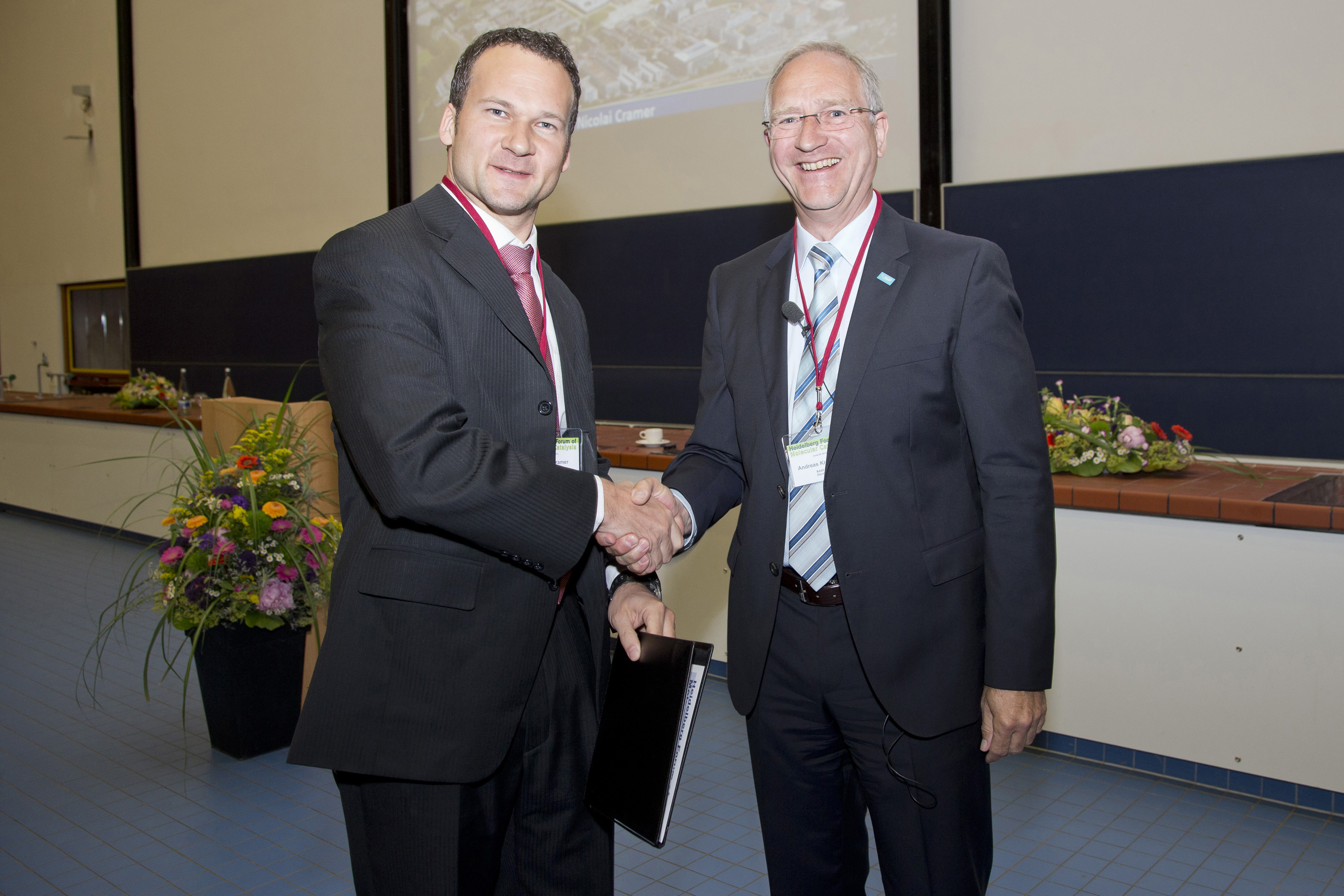
For his outstanding research contributions to catalytic processes in synthesis of biologically active molecules, Professor Dr Nicolai Cramer is receiving the BASF Catalysis Award 2013. Professor Cramer heads the laboratory of asymmetric catalysis and synthesis at the École Polytechnique Fédérale (EPF) in Lausanne, Switzerland. The prize, worth €10,000, was presented by Dr. Andreas Kreimeyer, Member of the Board of Executive Directors of BASF SE and Research Executive Director, at the “Heidelberg Forum of Molecular Catalysis,” a symposium of international experts organized jointly by Heidelberg University, Collaborative Research Center 623 “Molecular Catalysts” and BASF SE.
“Catalysis is an important key technology for the chemical industry and is an indispensable tool for accessing new feedstocks and developing new energy efficient production processes,” said Kreimeyer. As a company with a leading international research and development platform for catalysts, BASF therefore attaches particular importance to promoting excellent young researchers in this field.
With his research group centered at EPF Lausanne, Professor Cramer is working particularly in the field of enantioselective metal-catalyzed transformations and their implementation for the synthesis of complex biologically active molecules. The Cramer lab works on the development of broadly applicable catalytic methods for the selective functionalization of relatively inert C-H and C-C bonds with different transition-metal complexes.
“We are developing precise tools for all fields that produce molecules with high reactivity and selectivity. Our methods are suited for a faster synthesis because in medical research it is also essential to produce possible active ingredients rapidly. In this way, we have synthesized and identified molecules that show an anti-HIV effect. In doing this we closely collaborate with the life sciences faculty in Lausanne,” explained the prize winner Nicolai Cramer. “But other interesting fields also exist such as material sciences in which we can provide a better approach to molecules that for example are used for organic electronics.”
The “Heidelberg Forum of Molecular Catalysis,” an international scientific symposium of top class researchers based at Heidelberg University, is being held this year for the seventh time. The event offers scientists from academia and industry the opportunity to exchange news and information about the latest research activities in molecular catalysis. Plenary presentations are being held this year not only by the prizewinner but also by Professors Stephen L. Buchwald, MIT, Cambridge, Massachusetts, Peter Chen, ETH Zürich, Switzerland, and the Nobel Prize laureate Ei-ichi Negishi, Purdue University, Indiana.
Related News
-
News Novartis signs US$3.2 bn subcutaneous delivery deal with Alteogen
Swiss pharma giant secures access to Korean biotech's ALT-B4 hyaluronidase platform in milestone-heavy agreement, marking Alteogen's fourth major licensing deal of 2026 as competition intensifies in the subcutaneous drug delivery space.
-
News Women in Pharma: The philosophy of pharmaceutical leadership
In this latest instalment of our Women in Pharma series, we sit down with Clarissa Sowemimo-Coker, Chief Strategy Officer at Ambrose Healthcare and CPHI Middle East Advisory Board Member.
-
News The PSCI Supplier Partnership - Collaboration for Responsible Supply Chains
About the Pharmaceutical Supply Chain Initiative The Pharmaceutical Supply Chain Initiative (PSCI) is the leading, member-led association for pharmaceutical companies working collaboratively to build responsible supply chains. Founded in 2006 and es... -
News AstraZeneca shares plunge 8.9% after reports of BMS talks
Britain's largest drugmaker lost more than GBP£17 billion in market value following reports of preliminary merger discussions with Bristol Myers Squibb that could create a pharmaceutical giant worth nearly US$400 billion, though investors rem... -
News GSK announces £400 million investment in new Cambridge R&D centre
Pharmaceutical giant to establish flagship research facility on Cambridge Biomedical Campus as part of strategic pipeline acceleration
-
News The CPHI Sustainability Summit - Where Conversation Becomes Collaboration
The Report Was Never the Destination - “The future of pharmaceutical sustainability won’t be shaped by individual organisations working in isolation. It will be shaped by partnerships, shared expertise and the willingness to work diffe... -

News Trump's generic drug tariffs set to reshape global pharmaceutical supply chains
The US president has announced plans to impose tariffs of up to 200% on imported generic medicines from August 2028, giving manufacturers a two-year window to establish domestic production facilities. The move threatens to upend a global supply chain t... -
News Building Safer, More Responsible Pharmaceutical Supply Chains: PSCI Global Audit Insights
The Pharmaceutical Supply Chain Initiative (PSCI) has released its seventh annual Audit Findings Analysis Report, offering unprecedented insights into supplier practices across the global pharmaceutical and healthcare industry.With a record-breaking 24...