
CPHI Sustainability Summit Sponsor Interview – Significant Climate Risks in Pharma
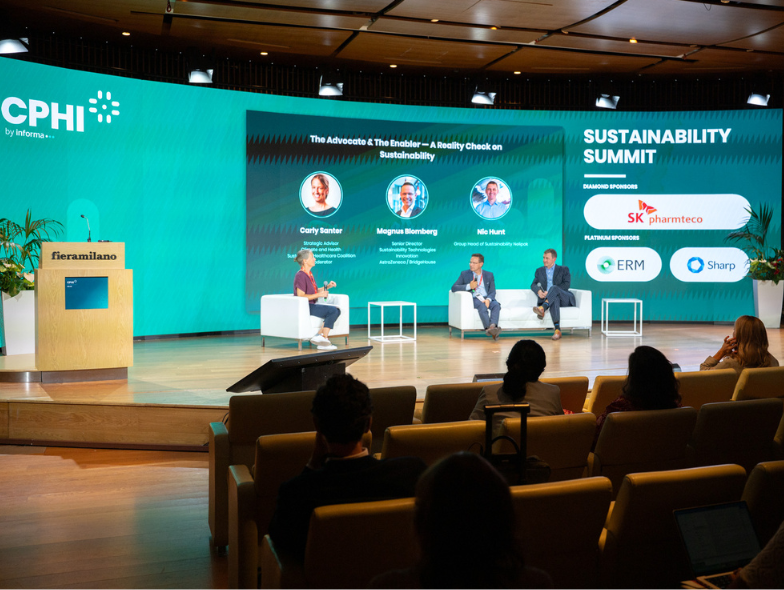
The inaugural CPHI Sustainability Summit took place this October at CPHI Milan 2026. ERM were integral to organising the Summit, bringing their expertise and aims for integrating sustainability and pharma.
In the following interview we hear from three ERM experts: Maria Dall, Partner, Global Industry Lead Pharmaceutical & Healthcare, James Hubbard, Partner, Climate Resilience Lead, and Jon Hughes, Partner, Sustainable Products & Supply Chain, who champion sustainability within the pharmaceutical sector.
What motivated ERM to sponsor the Sustainability Summit at CPHI Milan, and how does this align with your strategic priorities in the pharmaceutical sector?
Our rationale is to bring sustainability closer to the decisions that shape pharmaceutical businesses: protecting medicine supply, investing in manufacturing assets and working with suppliers. CPHI is uniquely important because it brings together pharmaceutical companies, suppliers and partners from across the full value chain, creating a setting where sustainability challenges can be addressed with the people who influence procurement, manufacturing, product and investment decisions.
We wanted to connect climate resilience, supply-chain decarbonisation and product sustainability, rather than discuss them separately.
Our message is practical: sustainability should inform how companies across the pharmaceutical value chain operate, collaborate and invest, not sit alongside the business as a separate commitment.
What are the most significant climate-related risks you're seeing pharmaceutical clients face, and how is ERM helping them build resilience into their operations?
Heat, water stress and wildfires have been the top stories of 2026, with many companies reporting direct impacts to their sites and indirect impacts on their supply chains. The implications of this extend beyond individual facilities to the availability of medicines, and the overall resilience of the healthcare sector.
For us, the important question is not simply “Which sites are exposed?” but “Where could that exposure interrupt a critical product?”. We recommend assessing assets, energy supply, cold chains and supplier dependencies together, then prioritising the points where failure would have the greatest consequence.
Can you share an example of how a pharmaceutical company has successfully integrated climate resilience planning without disrupting their operational continuity?
We don’t consider this to be a trade-off. Consider a manufacturing site facing increasing heat and water stress. We assess where cooling capacity, water availability or utility reliability could constrain production, then evaluate adaptations alongside planned maintenance and capital upgrades.
We’ve recently been delivering this for a top 5 global pharmaceutical company. They’ve assessed the thresholds for risk across all of their key sites, digging down in to the assets’ exposures and identifying the targeted interventions and capital expenditure needed to become resilient. This has led to building a business case that has been reviewed by the budgeting team and has now led to approval for investment across multiple sites.
Many pharmaceutical companies have now measured their Scope 3 emissions – what are the biggest challenges you're seeing in moving from measurement to meaningful supplier engagement and action?
The biggest challenges are data availability and accuracy, being able to target the emissions hotspots at a granular level and providing resources and capital to help suppliers meet the challenge of reducing Scope 3 emissions.
Are you seeing pharmaceutical companies collaborate on clean heat programmes, and what benefits does this collective approach offer? What challenges are preventing suppliers from fully transitioning?
Yes. There is a concrete example in ERM and Secaro’s Clean Heat Programme, whose founding members include AstraZeneca, Sanofi, UCB and Opella.
Collaboration sends a strong signal to suppliers that multiple customers are asking for the same thing and drives action. It also drives down the investment required by any one company to tackle this alone by sharing investment across the sector. ERM’s March announcement, “ERM, Secaro and AstraZeneca launch Clean Heat Programme to accelerate supply chain heat decarbonisation,” describes that implementation focus.
The collaboration angle is important because it creates a sector-level pull for change. Many pharmaceutical companies ultimately rely on the same suppliers, so fragmented requests for incremental improvements are less powerful than a coordinated demand signal for full transformation. Working together helps create constructive peer pressure, define a sector optimum and establish trusted benchmarks and best practice for suppliers to follow.
ERM’s agnostic position also matters. By investigating supplier sites and identifying the best technical and economic solutions for each context, the programme can move faster while giving participants confidence that the recommended solutions and partners have been independently vetted. Decisions endorsed through a credible sector process are less likely to be challenged later, which reduces friction for suppliers.
The economics are not uniform across clean heat technologies. Some solutions are already competitive and can improve value creation across the supply chain; others are currently too costly and may be better sequenced for later. A third category needs an additional boost to make the business case work. In some cases, the internal carbon price needed to justify a good capital project is lower than the long-term cost of buying environmental attribute certificates or biomethane, which can increase operating expenditure and erode competitiveness over time.
Where capital expenditure is required, scale becomes critical. The programme can bundle comparable opportunities to access more competitive financing and screen multiple projects at once for relevant subsidies, rather than asking each supplier to solve financing and incentives individually. That ability to aggregate demand, evidence and funding pathways is one of the main reasons a collective model can accelerate implementation.
How is product sustainability becoming a competitive differentiator in pharmaceutical market access, and what evidence are you seeing of this trend?
Environmental evidence is becoming more relevant to purchasing: NHS England’s Net Zero Supplier Roadmap includes carbon-reduction expectations and future product-footprinting requirements from April 2028. The French Medicines Regulation has required disclosure of product carbon footprint information since 2026, and this may be used by French authorities to support tender decisions.
We would therefore encourage companies to connect product assessment with design decisions. Ask where changes to chemistry, materials, packaging or manufacturing would make the greatest difference, while protecting clinical performance and safety.
The opportunity is not simply to label a product as “greener.” It is to demonstrate credible, quantified improvements that matter to customers, healthcare systems, and patients. Companies that can provide robust evidence of reduced carbon emissions, resource consumption, or waste, alongside maintained clinical performance, are increasingly better positioned to differentiate their products, strengthen stakeholder trust, and secure competitive advantage as sustainability becomes embedded in healthcare decision-making.
What strategies are proving most effective in building supply chain resilience whilst simultaneously advancing sustainability goals?
The most effective strategies are those that treat resilience and sustainability as mutually reinforcing rather than competing priorities. Leading pharmaceutical companies are moving beyond efficiency focused supply chains toward risk-informed, diversified networks, reducing dependence on single-source APIs, critical materials, and logistics routes while strengthening supply security and business continuity. This shift was a recurring theme at CPHI Milan 2026, where discussions focused on geopolitical risk, climate resilience, and medicine security.
A second key strategy is supplier decarbonisation coupled with resilience investments. Companies are increasingly partnering with suppliers on e.g. clean heat, renewable energy, and operational efficiency programmes that reduce emissions while lowering energy risk and improving long-term reliability. This reflects the growing industry focus on moving Scope 3 programmes from strategy to execution.
Finally, pharma leaders are integrating climate risk, procurement, manufacturing, and sustainability decision-making, using shared supplier data, digital traceability, and collaborative industry initiatives to identify vulnerabilities and accelerate action. The inaugural Sustainability Summit at CPHI highlighted that the next frontier is not setting ambitions, but translating them into practical measures that simultaneously improve resilience, reduce emissions and protect patient supply.
What role do industry consortia play in accelerating the clean heat transition, and how can companies maximise the value of participation?
Industry consortia play a critical role in accelerating the clean heat transition by creating a common platform for demand aggregation, knowledge sharing, supplier engagement, and practical problem-solving. The challenge is not a lack of available technologies, but overcoming common barriers such as limited internal expertise, uncertain business cases, fragmented supplier engagement, and competing capital priorities. Consortia help address these barriers by enabling companies to share experiences, standardise approaches, and provide stronger market signals to technology providers and energy partners.
Robert Williams from Astra Zeneca explained at CPHI in Milan, that the Clean Heat platform that they founded with Secaro and ERM, demonstrates that progress is most effective when collaboration is combined with implementation focused action. Successful programmes move beyond target setting and supplier questionnaires to identify technically viable clean heat opportunities, prioritise projects based on emissions reduction, resilience, and business value, and develop investable roadmaps that can be executed at site level.
To maximise the value of participation, companies should bring robust operational and supplier data, involve procurement, engineering, operations, sustainability, and finance teams, and focus on converting insights into funded projects. The greatest value comes when participation helps organisations move from ambition to delivery, accelerating decarbonisation while simultaneously improving energy security, operational resilience and long-term competitiveness across the supply chain.
Based on your work with pharmaceutical clients, what separates the companies that are successfully delivering on sustainability commitments from those still in the planning phase?
Our view is that companies successfully delivering on sustainability commitments have a clear ambition tied to tangible business value, and the ability to demonstrate progress through evidence that keeps investment moving. They understand how sustainability supports medicine supply security, operational resilience and long-term competitiveness, and translate that ambition into projects with accountable owners, budgets and milestones.
For the CPHI community, where manufacturers, suppliers, service providers and customers all influence delivery, this also requires coordinated action across the value chain. Procurement, operations, sustainability and finance teams need to work towards shared outcomes and help suppliers implement practical changes.
The distinction is not how polished the strategy is, but whether companies can demonstrate what has changed, what value is being created and how that evidence supports continued investment.
What were the most significant themes or insights that emerged from conversations at the summit?
Three themes stood out from conversations at the summit. First, sustainability is becoming fundamental to business decision-making and future success, rather than an afterthought. Discussions connected climate resilience and continuity of medicine supply with operational performance, while bringing product sustainability closer to commercial and design decisions.
Second, sustainability investments need clear evidence of their contribution to business value to secure continued funding. Ambition alone is not enough: companies need to demonstrate how projects reduce risk, strengthen resilience or improve competitiveness, and measure progress to sustain investment.
Third, collaboration is a strength of the pharmaceutical industry and an important route to implementation. There is a willingness to solve sustainability challenges together, particularly through supplier engagement and collective initiatives on clean heat and Scope 3 decarbonisation. The opportunity now is to translate that shared ambition into practical, investable projects that reduce emissions and protect medicine supply.
You can join ERM’s conversation on Supply Chain Decarbonisation here: https://www.erm.com/decarbonize-your-supply-chain/

Related News
-

News CPHI Milan 2026: From the Floor
Welcome to our live coverage from the heart of the pharmaceutical industry's most anticipated event of the year! As CPHI Milan 2026 unfolds across the sprawling exhibition halls of Fiera Milano, we're bringing you real-time insights, breakthrou... -

News The CPHI Sustainability Summit - Where Conversation Becomes Collaboration
The Report Was Never the Destination - “The future of pharmaceutical sustainability won’t be shaped by individual organisations working in isolation. It will be shaped by partnerships, shared expertise and the willingness to work diffe... -
News The Shift: Why Sustainability is Moving to the Centre of CPHI Milan 2026
CPHI Online contributor David Roach takes a look at how conversations around sustainability in the pharmaceutical industry can and must be transformed into actionable deliveries, and what the inaugural CPHI Sustainability Summit means for the industry. -

News CPHI Pharma Awards 2026: Recognising Excellence in an Evolving Industry
Submissions now open — deadline May 16