
CPHI Milan 2026: From the Floor
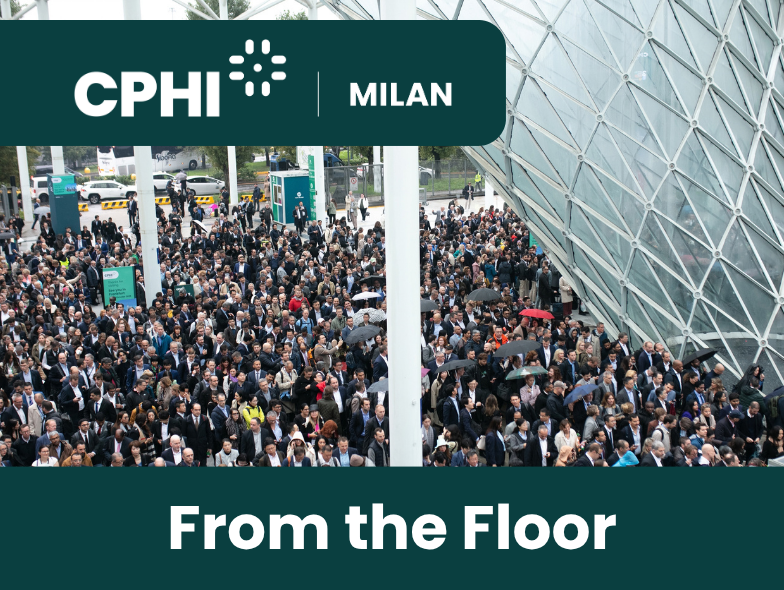
Welcome to our live coverage from the heart of the pharmaceutical industry's most anticipated event of the year! As CPHI Milan 2026 unfolds across the sprawling exhibition halls of Fiera Milano, we're bringing you real-time insights, breakthrough innovations, and the stories that matter most – straight from the show floor.
Over the coming days, our team will be navigating the bustling aisles, connecting with industry leaders, emerging innovators, and the brilliant minds shaping the future of pharma. From cutting-edge API developments and next-generation manufacturing technologies to sustainability initiatives and regulatory updates, we'll capture the pulse of an industry in transformation.
Whether you're here in Milan or following from afar, join us as we explore the trends, forge the connections, and uncover the innovations that will define pharmaceutical excellence in the years ahead. This is where deals are made, partnerships are forged, and the future of healthcare takes shape.
Stay tuned for daily updates, exclusive interviews, and behind-the-scenes moments from CPHI Milan 2026. The conversation starts now.
On Track with the CPHI Milan Track Sponsors
Our Track Sponsors keep our conference sessions filled to the brim with the most impactful discussions and ideas. Hear from this year's sponsors of the Manufacturing 5.0, Next-Gen Bio, and Supply & Formulation Excellence theatres and discover what awaits across this year's different theatres.
.png) Track Sponsor Interview – Supply excellence with Catalent
.png) Track Sponsor Interview - Anil Kane - Thermo Fisher Scientific
.png) Track Sponsor Interview - Next-Gen Bio - FUJIFILM Biotechnologies
CPHI Sustainability Summit
TThe CPHI Sustainability Summit is an inaugural initiative spearheaded by Informa Markets own Partnerships & Sustainability Director Silvia Forroova and the CPHI Sustainability Collective Steering Committee. Learn more about what's in store at the Summit this year!
.png) From Dialogue to Delivery: Pharma’s Next Chapter in Sustainability
.png) The CPHI Sustainability Summit - Where Conversation Becomes Collaboration
Day 3
One Assessment, Shared Benefits: Tackling Supplier Fatigue
For pharmaceutical suppliers, responding to multiple sustainability questionnaires can be a significant admin burden.
For the final Sustainability Theatre session at CPHI Milan 2026, Camille Messer (Global Head of Sector Initiatives, EcoVadis) outlined how the Responsible Health Initiative (RHI) is seeking to tackle this through shared assessments.
According to the presentation, RHI brings together 13 pharma and healthcare companies, collaborating on sustainable procurement, decarbonisation, and labour and human rights.
Using EcoVadis’ evidence-based rating platform, participating companies can share supplier assessments, reducing the need for repeated questionnaires.
The initiative operates under governance and competition-law safeguards, with restrictions on sharing commercially sensitive information.
The aim is straightforward: less duplication, more consistent sustainability information and a more manageable reporting process, particularly for smaller suppliers.
Another example of industry collaboration being put to work on a practical, shared challenge.
Strength in Numbers: A Collective Voice For Life Science Manufacturing
When it comes to shaping European regulation, there’s something to be said for strength in numbers.
At What’s Next for Life Sciences Manufacturing in Europe over at Global Pharma Outlook… Adrian Samson (Secretary General of the Life Science Manufacturers Association / LSMA) and John Clarke (LSMA President and Global Head of Government Affairs and Policy at Cytiva) discussed the value of a trade association in Brussels.
Just 14 months old, the LSMA is bringing manufacturers together to engage with policymakers, pool expertise and raise shared concerns within established competition-law safeguards.
And there’s plenty to discuss. From proposed PFAS restrictions to EU Biotech Acts and animal by-products legislation, the regulatory agenda is considerable.
According to LSMA, early conversations have been encouraging. The ambition? To help shape regulation as they develop, rather than react once decisions have been made.
Day 2
Scope 3 – How Leading Pharma Organisations Are Moving From Strategy to Action to De-carbonise Their Supply Chains – Clean Heat
Back to the Sustainability Spotlight Theatre.
What if fossil fuels aren’t just a sustainability problem, but a business risk?
That was the starting point for today’s clean heat session featuring Rob Williams (Astra Zeneca), Emily Prior (Sicario) and John Hughes (ERM).
Industrial heat remains heavily dependent on fossil fuels, exposing businesses to emissions, volatile prices and uncertainty of supply. But the technology isn’t necessarily the problem. The challenge is building a compelling business case that unlocks high level corporate backing… and investment.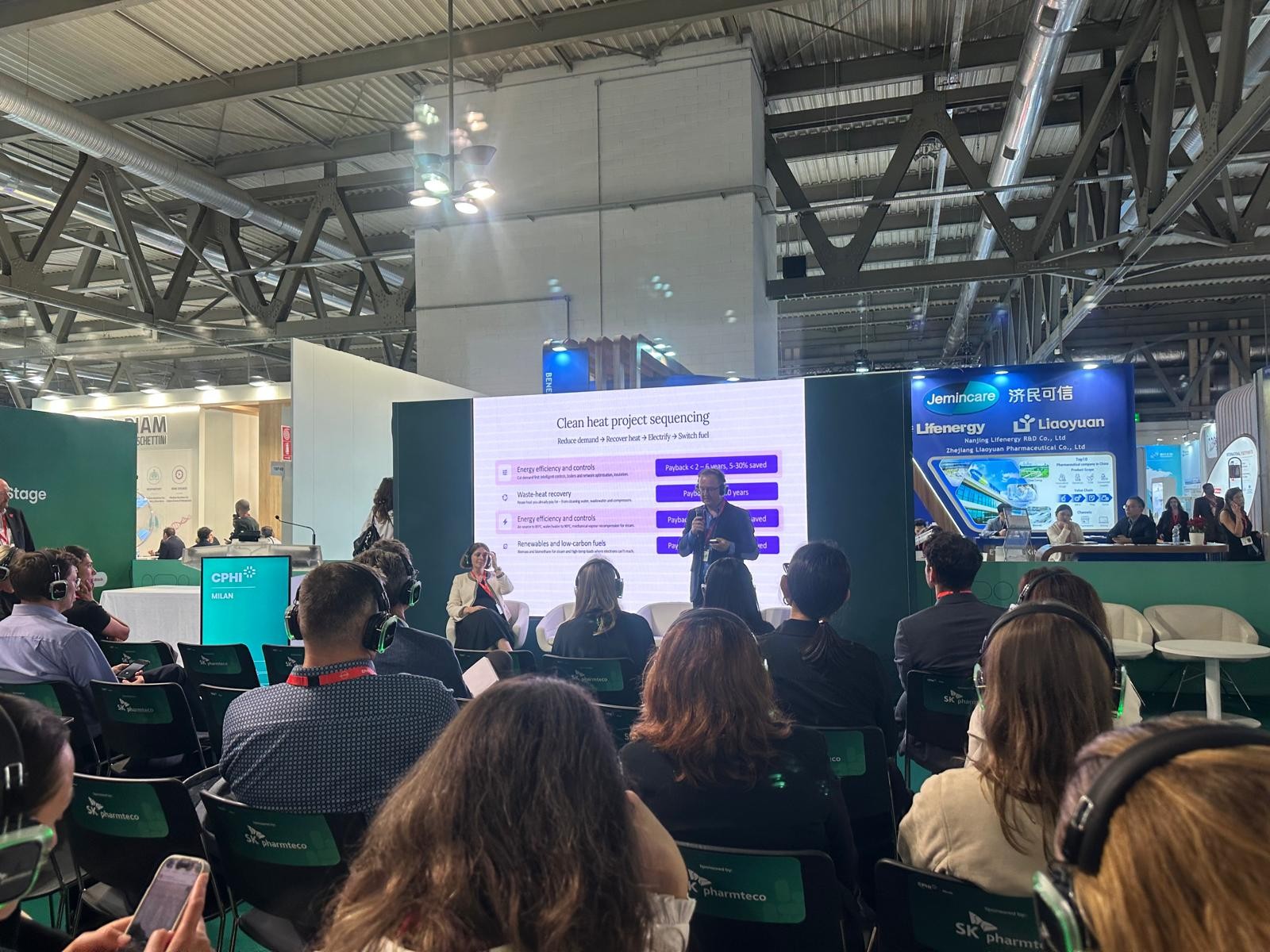
The initiative is gaining real traction too, recently featured in Forbes Magazine article under the headline: How Big Pharma is Turning Industrial Heat Into a Strategic Asset.
The approach is site-by-site, bringing key engineering and operational teams into the process, and finding the right mix of solutions.
This works for old sites – and when asked from the room – new sites? Start early, said ERM’s John Hughes, and you can design the standard in from Day 1.
Because clean heat isn’t just about cutting carbon. It’s about cutting risk.
Workshop: From Commitment to Action: Implementing Sustainability at Scale and Across the Pharma Value Chain
Day 2 of the Sustainability Summit has been all about getting to work in the breakout rooms of Stella Polare.
In this well-attended session, experts from across the pharma chain: Dagmar Traxle (Sanofi), Alissa Monk (Ten23 Health), James Swinyard (My Green Lab), Valeria Cavatorta (Chiesi Pharmaceuticals), and Jan Valsler (AstraZeneca) brought different challenges, expertise, and approaches to the room… before heading off to different corners and handing things over to the tables.
Groups shared experiences, observations, wishes and tested ideas by working together on what might actually move things forward. The results are still being gathered and will be looked at and shared.
Watch this space.
“Nobody will pay for it.”
An all too familiar response when a more sustainable option comes with a bigger price tag. But does there have to be where the conversation ends?
Not according to Marwin Krull (Alliance to Zero/Körber Pharma). His workshop – with Corrine Herger (Alliance to Zero/Datwyler) – on sustainable financing looked at ways of making greener alternatives financially possible, but also where things still get somewhat stuck, including contract-based financing and IP around joint developments.
The hope is that people leave Milan with a different instinct. Not “nobody will pay for it”, but “how can we make it work?”.
Practical tools, practical questions
A workshop on Practical Tools and Metrics for Greener and More Sustainable API Synthesis showed an engaged room where answers to difficult questions and equations can be found.
Led by Isamir Martinez of the ACS Green Chemistry Institute and Dr Olivier Dapremont of SK pharmteco, the session covered green chemistry principles, solvents and crucially, explored tools already available to help make greener choices in API synthesis.
A technical hitch in the room meant the tools couldn’t be demonstrated as planned… but this arguably made it more of a workshop with relevant questions and a practical conversation about how the tools can be used.
The next step? Simple.
Go online and try them. They are free.
Day 1
CPHI Celebration
As always, the first day of the conference closes with a party – the CPHI Celebration – where we host the prize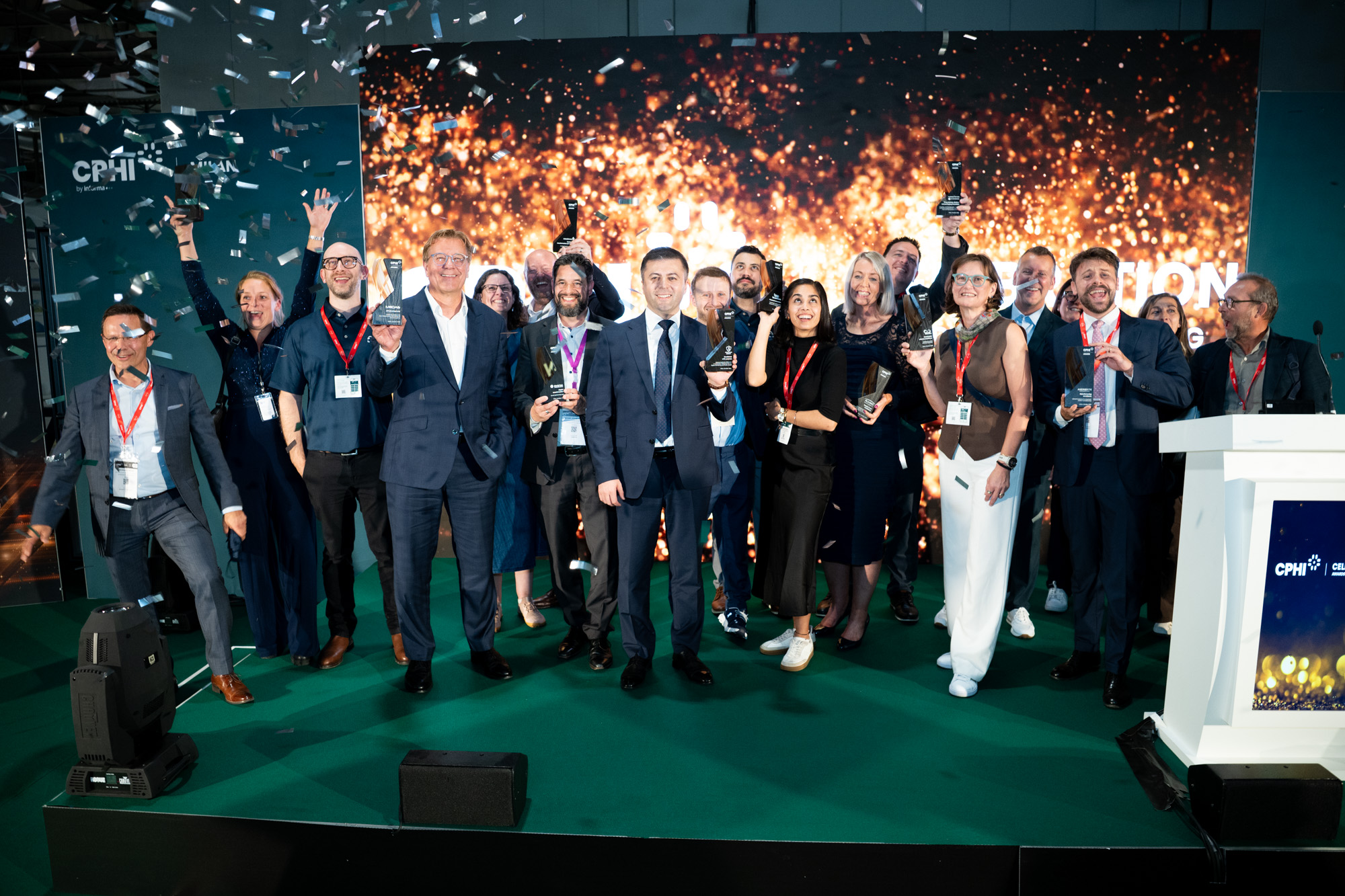 giving for the annual CPHI Pharma Awards. As with the rest of the show, this year promised to be bigger and better with a host of new award categories, bringing the total number of prizes to 15.
The evening was a great success where we were happy to celebrate all those who won, acknowledging the incredible work people, companies and even governments have been doing over the past year to make pharma more sustainable, more accessible, and more futuristic than ever before.
See the full details about all our award winners for 2026 here.
From collaboration to action
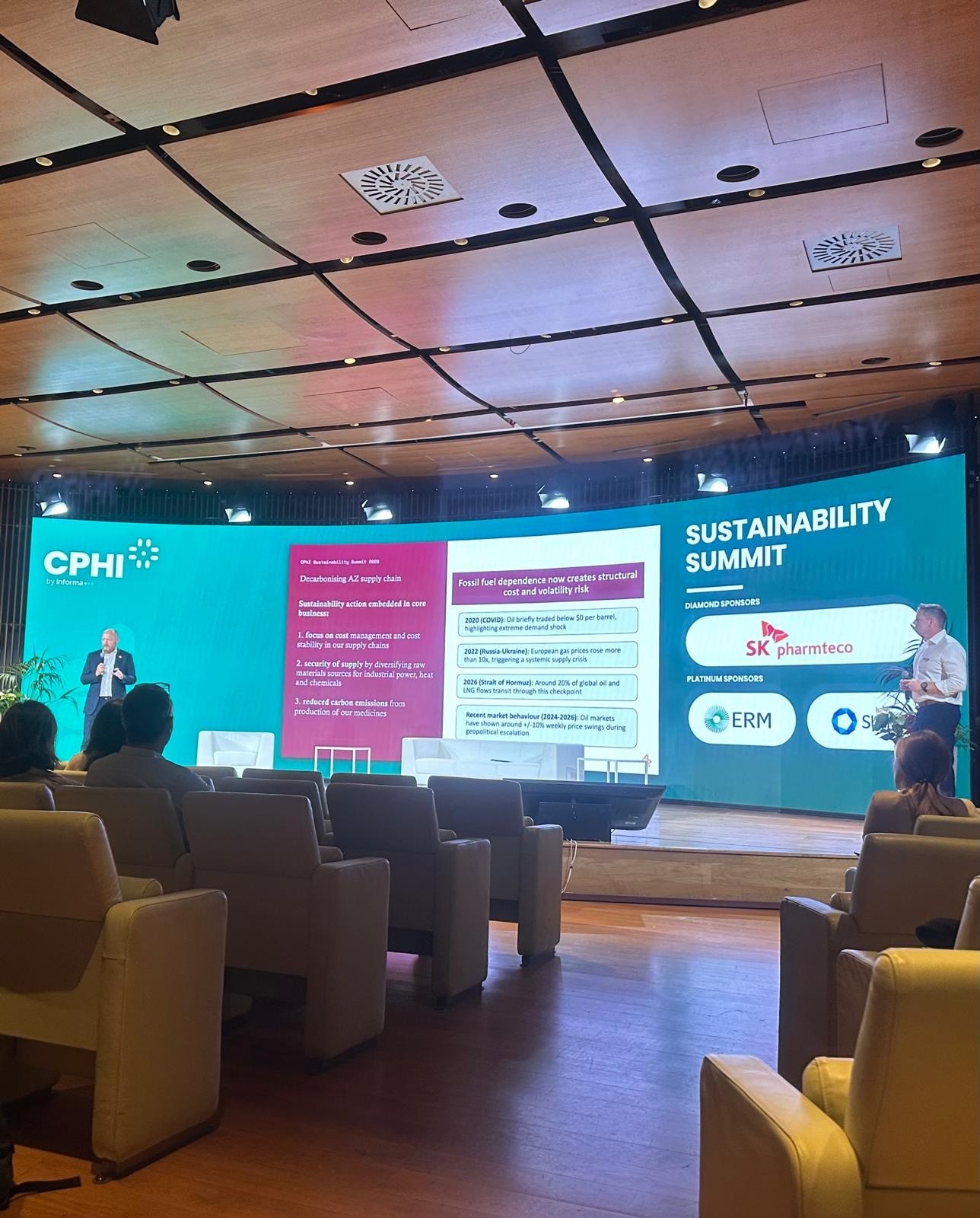 Silvia Forroova, Founder of the Sustainability Collective, opened the inaugural Sustainability Summit by reflecting on the hard work and long gestation behind it… and, above all, the collaborative effort that has brought the Sustainability Collective to this point.
Now, she said, the time feels right to take that work forward under the CPHI banner and bring a much wider community into the conversation.
But the next two days are not simply about talking. Forroova challenged delegates to use the Summit as an opportunity to be inspired… and then to take that inspiration back into their businesses.
The ambition is clear: share ideas, learn from each other, and turn inspiration into action.
Look beyond the noise
In a hugely positive opener at the Sustainability Summit, keynote speaker Sony Kapoor offered a welcome challenge to the relentlessly negative news cycle: learn to distinguish signal from noise.
While political turbulence and polarisation dominate the headlines, Kapoor pointed to a different story unfolding across Sub-Saharan Africa and Asia, where talent, investment, opportunity and economic growth are creating multiple new engines of global progress.
That matters for climate change, too. The technology to tackle it exists, he argued, and capital is increasingly looking for longer-term opportunities. Talent, meanwhile, is globally distributed.
The implication is both optimistic and practical: the future doesn’t have to be determined by today’s loudest voices. A world with multiple growth engines is stronger than one dependent on a single one.
And everyone in the room has agency.
The headlines may be noisy. The opportunity is global… and the signal is there if we choose to look for it.
Leadership in an uncertain industry: from the floor
Supply-chain vulnerability, cost pressure, AI and uncertainty dominated a wide-ranging leadership panel at the Sustainability Summit, but one theme kept returning; trust.
With Dr Mina Rauk, Anna-Pamela Faye Freeman, Dr Adriana Kietzieske-Menkold, Jean-Christophe Hebert, Andrea Rothmayer and Christian Bardoff, the discussion explored how pharma can use data and AI for predictive maintenance, testing and greater efficiency without losing human judgement. Sharing data could unlock further gains, but only where IP, data quality, confidentiality and governance are protected.
The same principle applies to people. As Faye Freeman put it, there is “no normal” after COVID. Leaders need to communicate, listen, upskill and bring their teams with them through change. Cultural differences matter too: there is no single right way to lead.
The message on sustainability was equally pragmatic: embed it early, rather than treating it as an additional cost.
Looking ahead, the panel called for better management of uncertainty, stronger partnerships and faster collaboration.
Perhaps the simplest message: don’t just talk about partnership. Trust it, and use it.
Regional perspectives on sustainability
Can regionalisation strengthen resources rather than simply duplicate them? And can sustainability constraints become drivers for change?
These were among the questions explored in Mapping the Supply Chain: Regional Perspectives on Sustainability with Ximena Stawsky (Merck), Beatrice Eccidio (Zentiva), Jose-Francisco Vallejo-Carrera (Sanofi) and moderator - Mary Poddar (3Degrees).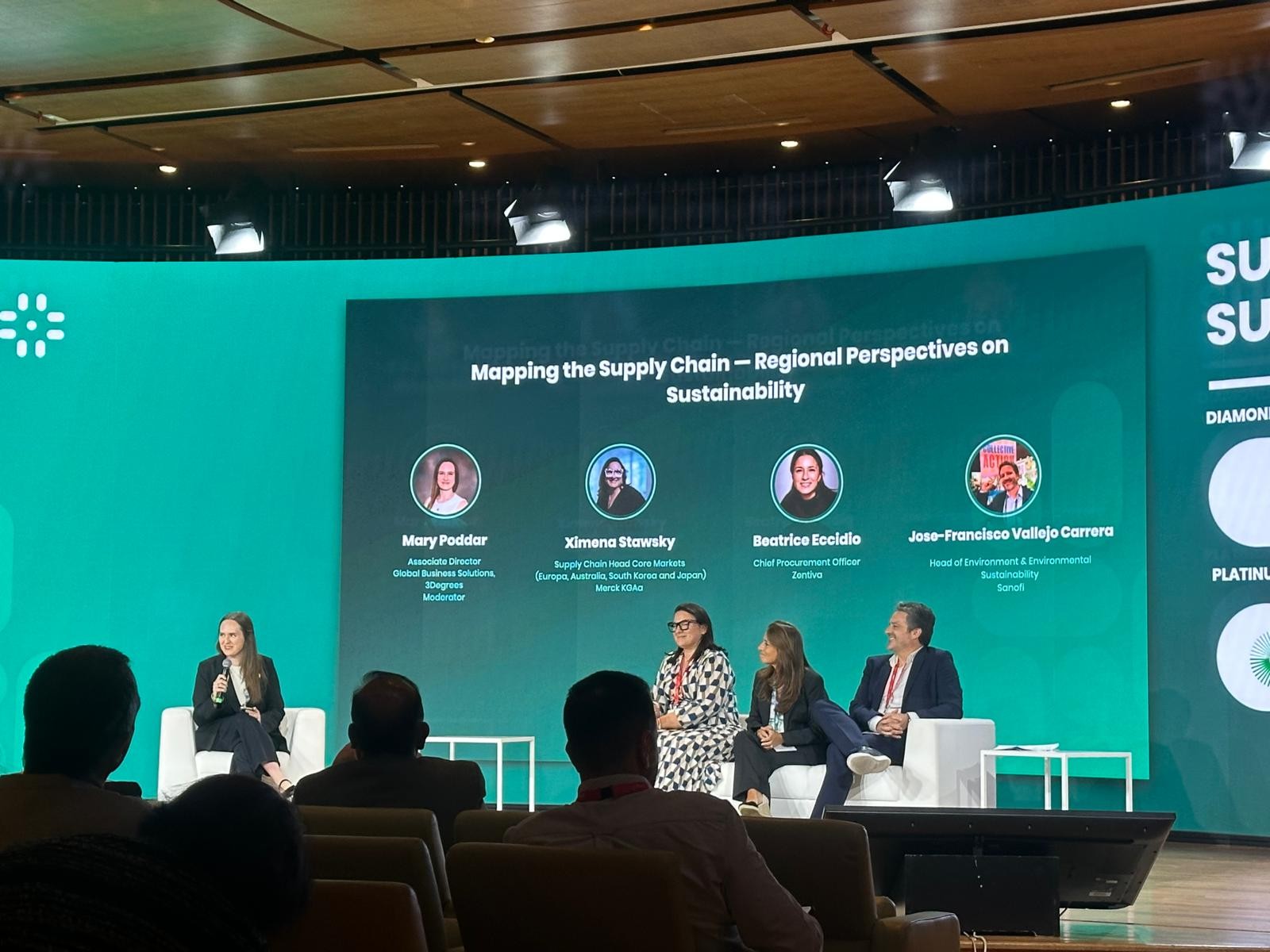
One compelling example was Merck’s recyclable plastic box, made using plastic waste recovered from the oceans and tested in two Spanish hospitals. The results have been phenomenal, raising the question of what could happen if solutions like this were scaled up more widely.
But scaling requires balance: navigating regulation while continuing to deliver safe, affordable medicines to every patient, every day. The panel also stressed the importance of looking beyond Tier 1. Water scarcity, for example, may represent a much greater risk further upstream.
Perhaps the strongest takeaway was simple: we often perceive constraints as risks, but they can also be drivers.
And the panel ended the discussion with this: Sustainability is a team sport… requiring strong relationships, trust, transparency and, above all, action.
Sustainability as a catalyst for change
Sustainability is often framed as a challenge for organisations to solve. But what if change starts much closer to home?
A fireside reality-check discussion on The Advocate for the Enabler with moderator Carly Santer (Sustainable Healthcare Coalition), and Nic Hunt (Nelipak) and Magnus Blomberg (AstraZeneca / BridgeHouse) explored how individual choices can become organisational action… and ultimately contribute to wider societal change.
There is a huge amount of positive energy already beneath the surface. The challenge is to lean in: to share the stories, give people permission to get involved and help them feel part of something bigger.
Personal choices can prompt bigger questions about how businesses operate. But meaningful progress also requires collaboration across entire value chains, particularly on Scope 3 emissions. Innovation, investment and supportive policy will be needed to move solutions from pilot to scale.
Data and targets matter, but emotion, purpose and the prospect of a liveable planet can be more powerful catalysts for action. As will recognising the urgency of the climate situation and the harsh reality of targets and timescales.
But perhaps the biggest shift is recognising that innovation is not just about technology: it can be about changing the business model itself.
Positive pressure: how clients and suppliers can move the needle on emissions reduction
Sometimes pressure is a good thing.
Rob Williams (AstraZeneca) and Hywel Woolf (Sharp Services) offered a great working example of what happens when customer and supplier put a little positive pressure on each other… and turn sustainability commitments into something real.
Targets backed from the top have changed the way they work together: specifications are changing, data is being shared, teams are connecting earlier and suppliers are becoming part of the solution.
And it’s working. Scope 1 and 2 emissions are coming down. Scope 3 is harder – nobody controls the whole supply chain – so the answer is to be open about the challenge and tackle it together.
There was a refreshing simplicity to the approach. Don’t reinvent the wheel. Find what works. Connect the right people. Make it better. Keep learning. Inspire and enact.
And an industry learn? With 2030 getting closer, sustainability can’t simply be passed up or down the supply chain.
Day 1 has already been a blur! Don't let the queues intimidate you - security is swift and before you know it, you're met with a whirlwind of collaboration and networking. We can't wait to see what the day brings!
.jpg)
Day 0
The day has finally arrived! The whole team is on-site, we're checking in with AV, swapping USBs, and ticking off our massive to-do list one-by-one. It's great to be back at the Fiera Milano, and we can't wait to update you on everything happening on the showfloor.
Stay tuned!
Related News
-
News Novartis signs US$3.2 bn subcutaneous delivery deal with Alteogen
Swiss pharma giant secures access to Korean biotech's ALT-B4 hyaluronidase platform in milestone-heavy agreement, marking Alteogen's fourth major licensing deal of 2026 as competition intensifies in the subcutaneous drug delivery space.
-

News Women in Pharma: The philosophy of pharmaceutical leadership
In this latest instalment of our Women in Pharma series, we sit down with Clarissa Sowemimo-Coker, Chief Strategy Officer at Ambrose Healthcare and CPHI Middle East Advisory Board Member.
-
News The PSCI Supplier Partnership - Collaboration for Responsible Supply Chains
About the Pharmaceutical Supply Chain Initiative The Pharmaceutical Supply Chain Initiative (PSCI) is the leading, member-led association for pharmaceutical companies working collaboratively to build responsible supply chains. Founded in 2006 and es... -
News AstraZeneca shares plunge 8.9% after reports of BMS talks
Britain's largest drugmaker lost more than GBP£17 billion in market value following reports of preliminary merger discussions with Bristol Myers Squibb that could create a pharmaceutical giant worth nearly US$400 billion, though investors rem... -
News GSK announces £400 million investment in new Cambridge R&D centre
Pharmaceutical giant to establish flagship research facility on Cambridge Biomedical Campus as part of strategic pipeline acceleration
-

News The CPHI Sustainability Summit - Where Conversation Becomes Collaboration
The Report Was Never the Destination - “The future of pharmaceutical sustainability won’t be shaped by individual organisations working in isolation. It will be shaped by partnerships, shared expertise and the willingness to work diffe... -

News Trump's generic drug tariffs set to reshape global pharmaceutical supply chains
The US president has announced plans to impose tariffs of up to 200% on imported generic medicines from August 2028, giving manufacturers a two-year window to establish domestic production facilities. The move threatens to upend a global supply chain t... -

News Building Safer, More Responsible Pharmaceutical Supply Chains: PSCI Global Audit Insights
The Pharmaceutical Supply Chain Initiative (PSCI) has released its seventh annual Audit Findings Analysis Report, offering unprecedented insights into supplier practices across the global pharmaceutical and healthcare industry.With a record-breaking 24...