
Essential malaria parasite genes revealed
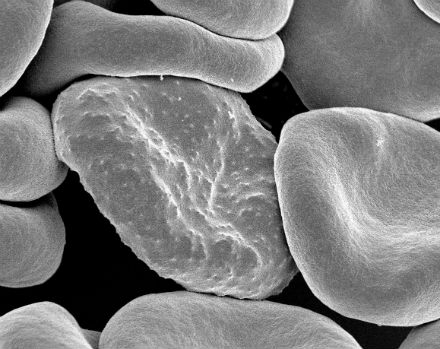
Electron micrograph of red blood cells infected with Plasmodium falciparum, the parasite that causes malaria in humans.
NIAID-funded research could aid antimalarial drug development.
Researchers have exploited a quirk in the genetic make-up of the deadly malaria parasite, Plasmodium falciparum, to create 38,000 mutant strains and then determine which of the organism’s genes are essential to its growth and survival. P. falciparum is responsible for about half of all malaria cases and 90% of all malaria deaths. New information about the parasite’s critical gene repertoire could help investigators prioritize targets for future antimalarial drug development.
The international research team led by John H. Adams, of the University of South Florida, was supported by the National Institute of Allergy and Infectious Diseases (NIAID), part of the National Institutes of Health. The study appears in the 4 May issue of Science. Rays H.Y. Jiang, of University of South Florida, and Julian C. Rayner, of the Wellcome Trust Sanger Institute, UK, collaborated with Dr Adams in this research.
The complete genetic sequence of P. falciparum was determined more than a decade ago, but the functions of most of its genes remain unknown, and until now only a few hundred mutant strains had been created in the lab. The difficulties in manipulating P. falciparum stem in part from the extremely high percentage of adenine or thymine (two of the four chemical building blocks that make up DNA) in its genome. Standard methods for creating mutants rely on more variation in gene sequences and so do not work on P. falciparum. In the new research, Dr Adams and his colleagues created mutated versions of nearly all the parasite’s 6,000 genes with a technique that preferentially targets areas rich in adenine and thymine, thus exploiting the very feature that had foiled previous attempts at genetic manipulation.
The team used computational analysis to distinguish non-essential genes (those that could be mutated) from essential, non-mutable ones. About 2,600 were identified as indispensable for growth and survival during the parasite’s asexual, blood stage. These included ones associated with P. falciparum’s ability to resist antimalaria drugs, highlighting them as high-priority targets for new or improved antimalarial compounds, the researchers note.
Related News
-

News GSK announces £400 million investment in new Cambridge R&D centre
Pharmaceutical giant to establish flagship research facility on Cambridge Biomedical Campus as part of strategic pipeline acceleration
-

News Understanding the Benefits and Advances of Cleanroom Technology
In an industry where precision and sterility are crucial concerns, cleanrooms play a vital role in maintaining the integrity of pharmaceutical products like drugs, vaccines, and other medical products. So, what is a cleanroom?
-

News AbbVie secures GBP£1.2 billion deal for Gilgamesh’s psychedelic programme
AbbVie has penned a significant agreement to acquire the bretisilocin programme from Gilgamesh Pharmaceuticals for up to £1.2 billion, marking a bold step in the pharmaceutical giant's quest to develop treatments for psychiatric disorders. -

News Gates Foundation commits US$2.5 billion to women’s health research
The Bill & Melinda Gates Foundation has announced a substantial US$2.5 billion commitment to accelerate research and development focused exclusively on women's health through 2030.
-

News Mid-year review: notable FDA drug approvals of 2025
As we fly past the halfway point of 2025, the pharmaceutical landscape reliably continues to evolve with innovative therapies addressing critical medical needs. The FDA has already approved 17 groundbreaking medications this year, each representin... -

News US FDA announces new priority vouchers for accelerated review times
The US FDA announced a new priority program for drug developers – the Commissioner’s National Priority Voucher (CNPV) program aims to enhance the health interests of the US by allowing drug developers to redeem a voucher, shortening th... -

News Google-backed start-up raises US$600 million to support AI drug discovery and design
London-based Isomorphic Labs, an AI-driven drug design and development start-up backed by Google’s AI research lab DeepMind, has raised US$600 million in its first external funding round by Thrive Capital. The funding will provide further power t... -

News AstraZeneca to invest US$2.5 billion in Beijing R&D centre
Amid investigations of former AstraZeneca China head Leon Wang in 2024, AstraZeneca have outlined plans to establish its sixth global strategic R&D centre in China. Their aim is to further advance life sciences in China with major research and manufact...