
Fresh data on protein interactions in Alzheimer’s disease
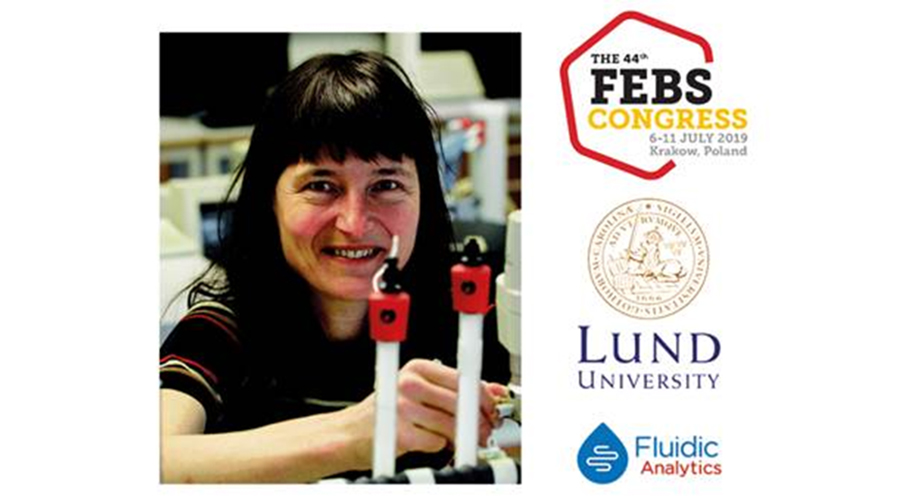
Professor Sara Linse will highlight the Fluidity One-W as an influential technology for protein interaction analysis during plenary lecture at FEBS 2019.
Demonstrates the unique ability of diffusional sizing to assess protein binding in-solution and for difficult-to-study systems.
Fluidic Analytics’ diffusional sizing technology has been influential in a recent study that investigates protein binding and self-assembly in Alzheimer’s disease. This work will be presented by Professor Sara Linse of Lund University, Sweden, during the FEBS/EMBO Women in Science Award plenary lecture at FEBS 2019, Krakow, Poland (Sunday 7 July at 2 pm). Her work on the mechanism of amyloid β aggregation and the role of inhibitors demonstrates the unique ability of diffusional sizing to assess protein binding in-solution and for difficult-to-study systems.
Fluidic Analytics will host an extended Q&A session with Professor Linse at their booth (number 7) at 3 pm following her plenary talk. Visitors to the Fluidic Analytics booth will also be able to have an early look at the Fluidity One-W before its official launch later this year. This instrument has the ability to assess on-target protein interactions in solution and in crude biological backgrounds – opening up the possibilities for detailed analysis of proteins in their near-native states and natural environments. The system is easy-to-use, and based on the well-understood relationship between size and diffusion rate, providing researchers with true confidence in the quality and accuracy of their data.
Professor Sara Linse, Department of Biochemistry and Structural Biology, Lund University commented: “During our research into protein amyloid formation, we have used many different techniques for assessing protein interactions – all with different limitations and advantages. With diffusional sizing, we were able to confidently generate accurate and complete in-solution data using amyloid proteins to connect stoichiometry and binding affinities with protein self-assembly. The data we will present at FEBS 2019 could provide key insights for novel therapeutic approaches in Alzheimer’s disease. The Fluidity One-W has contributed significantly to this detailed understanding.”
With applications ranging from neurobiology and cell signalling to drug discovery, the potential impact of diffusional sizing in fundamental scientific research is vast and spans many research areas. Dr Sean Devenish, Head of R&D at Fluidic Analytics explained: “The unique capabilities of the Fluidity One-W position it as the only viable option for analysing difficult-to-study proteins, like amyloid fibrils, in solution. Researchers gain the best insight into what their protein of interest is interacting with, and how, even in complex backgrounds such as crude lysates. The technology is opening up many new avenues of research into protein interactions and expanding the systems that can be studied, and Professor Linse’s recent work is a great example of what’s possible with this new approach to protein analysis.”
Related News
-
News Novartis signs US$3.2 bn subcutaneous delivery deal with Alteogen
Swiss pharma giant secures access to Korean biotech's ALT-B4 hyaluronidase platform in milestone-heavy agreement, marking Alteogen's fourth major licensing deal of 2026 as competition intensifies in the subcutaneous drug delivery space.
-

News Women in Pharma: The philosophy of pharmaceutical leadership
In this latest instalment of our Women in Pharma series, we sit down with Clarissa Sowemimo-Coker, Chief Strategy Officer at Ambrose Healthcare and CPHI Middle East Advisory Board Member.
-
News The PSCI Supplier Partnership - Collaboration for Responsible Supply Chains
About the Pharmaceutical Supply Chain Initiative The Pharmaceutical Supply Chain Initiative (PSCI) is the leading, member-led association for pharmaceutical companies working collaboratively to build responsible supply chains. Founded in 2006 and es... -
News AstraZeneca shares plunge 8.9% after reports of BMS talks
Britain's largest drugmaker lost more than GBP£17 billion in market value following reports of preliminary merger discussions with Bristol Myers Squibb that could create a pharmaceutical giant worth nearly US$400 billion, though investors rem... -
News GSK announces £400 million investment in new Cambridge R&D centre
Pharmaceutical giant to establish flagship research facility on Cambridge Biomedical Campus as part of strategic pipeline acceleration
-

News The CPHI Sustainability Summit - Where Conversation Becomes Collaboration
The Report Was Never the Destination - “The future of pharmaceutical sustainability won’t be shaped by individual organisations working in isolation. It will be shaped by partnerships, shared expertise and the willingness to work diffe... -

News Trump's generic drug tariffs set to reshape global pharmaceutical supply chains
The US president has announced plans to impose tariffs of up to 200% on imported generic medicines from August 2028, giving manufacturers a two-year window to establish domestic production facilities. The move threatens to upend a global supply chain t... -
News Building Safer, More Responsible Pharmaceutical Supply Chains: PSCI Global Audit Insights
The Pharmaceutical Supply Chain Initiative (PSCI) has released its seventh annual Audit Findings Analysis Report, offering unprecedented insights into supplier practices across the global pharmaceutical and healthcare industry.With a record-breaking 24...