
Krystal microplate enables development of drug testing assay
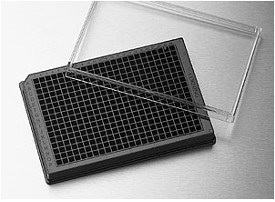
Scientists at the NCBS using Krystal 384-well black microplates to produce a standard drug testing assay for Plasmodium vivax infection.
Porvair Sciences reports that the National Center for Biological Sciences (NCBS) in Bangalore, India is using its Krystal 384 black microplate to produce a standard drug testing assay for Plasmodium vivax infection.
The NCBS is a leading national institute whose faculty members undertake research in the frontier areas of biology. Scientists at the NCBS use experimental and computational approaches to study molecules, cells and organisms creating an understanding of the biology at each of these levels to advance an integrated view of life processes.
In their research, the NCBS is using Krystal 384-well black microplates as the micro-environment to grow the cells infected with small numbers of parasites. Researchers are then treating the Krystal 384 black plates with different concentrations of drugs to check the effect on the infection and the development of the Plasmodium vivax parasites inside the cells.
Dr Mulaka Maruthi, a senior NCBS researcher commented "Because they are manufactured to a very high flatness tolerance the Porvair Sciences Krystal 384-well black plates are very convenient to use with both our inverted microscope and High Content Screening machine. The clear plate bottom permits direct microscopic viewing or HCS imaging and the images are of high resolution". Dr Maruthi added "Using the Krystal 384-well black plates we have been able to minimize the number of cells for seeding, use smaller numbers of parasites, and lower volumes of drugs. Overall the Krystal 384 black plate has enabled us to perform these experiments in a single plate instead of many 96 well plates or other well formats".
The Krystal 384-well microplate range incorporates novel square wells with a large liquid capacity of 120µl per well, increasing the achievable sensitivity of most HTS assays. Using a proprietary manufacturing technique, the Krystal 384 offers market leading plate flatness (+/- 0.1mm tolerance) that translates into a significant increase in measurement precision and elimination of read errors when performing cell based assays using fluorescent or luminescent imaging. All tissue-culture treated plates are supplied lidded and sterile, in individual bags.
Related News
-
News GSK announces £400 million investment in new Cambridge R&D centre
Pharmaceutical giant to establish flagship research facility on Cambridge Biomedical Campus as part of strategic pipeline acceleration
-
News Understanding the Benefits and Advances of Cleanroom Technology
In an industry where precision and sterility are crucial concerns, cleanrooms play a vital role in maintaining the integrity of pharmaceutical products like drugs, vaccines, and other medical products. So, what is a cleanroom?
-

News AbbVie secures GBP£1.2 billion deal for Gilgamesh’s psychedelic programme
AbbVie has penned a significant agreement to acquire the bretisilocin programme from Gilgamesh Pharmaceuticals for up to £1.2 billion, marking a bold step in the pharmaceutical giant's quest to develop treatments for psychiatric disorders. -

News Gates Foundation commits US$2.5 billion to women’s health research
The Bill & Melinda Gates Foundation has announced a substantial US$2.5 billion commitment to accelerate research and development focused exclusively on women's health through 2030.
-

News Mid-year review: notable FDA drug approvals of 2025
As we fly past the halfway point of 2025, the pharmaceutical landscape reliably continues to evolve with innovative therapies addressing critical medical needs. The FDA has already approved 17 groundbreaking medications this year, each representin... -

News US FDA announces new priority vouchers for accelerated review times
The US FDA announced a new priority program for drug developers – the Commissioner’s National Priority Voucher (CNPV) program aims to enhance the health interests of the US by allowing drug developers to redeem a voucher, shortening th... -
News Google-backed start-up raises US$600 million to support AI drug discovery and design
London-based Isomorphic Labs, an AI-driven drug design and development start-up backed by Google’s AI research lab DeepMind, has raised US$600 million in its first external funding round by Thrive Capital. The funding will provide further power t... -
News AstraZeneca to invest US$2.5 billion in Beijing R&D centre
Amid investigations of former AstraZeneca China head Leon Wang in 2024, AstraZeneca have outlined plans to establish its sixth global strategic R&D centre in China. Their aim is to further advance life sciences in China with major research and manufact...