
Microneedle patch delivers localized cancer immunotherapy to melanoma
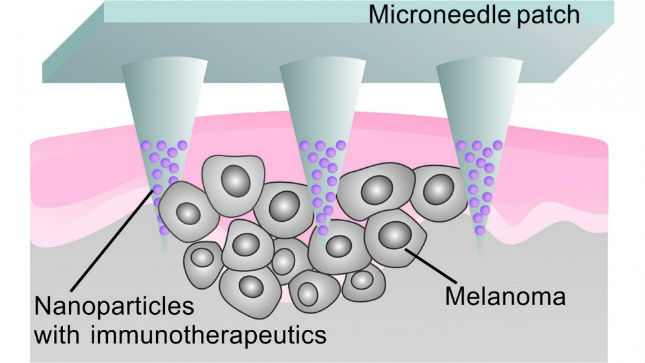
Researchers developed a patch that uses microneedles to deliver anti-PD-1 antibodies locally to the skin tumour.
Biomedical engineering researchers at North Carolina State University and the University of North Carolina at Chapel Hill have developed a technique that uses a patch embedded with microneedles to deliver cancer immunotherapy treatment directly to the site of melanoma skin cancer. In animal studies, the technique more effectively targeted melanoma than other immunotherapy treatments.
In the immune system, T cells are supposed to identify and kill cancer cells. To do their job, T cells use specialized receptors to differentiate healthy cells from cancer cells. But cancer cells can trick T cells. One way cancer cells do this is by expressing a protein ligand that binds to a receptor on the T cells to prevent the T cell from recognizing and attacking the cancer cell.
Recently, cancer immunotherapy research has focused on using “anti-PD-1” (or programmed cell death) antibodies to prevent cancer cells from tricking T cells.
“However, this poses several challenges,” says Chao Wang, co-lead author of a paper on the microneedle research and a postdoctoral researcher in the joint biomedical engineering program at NC State and UNC-Chapel Hill. “First, the anti-PD-1 antibodies are usually injected into the bloodstream, so they cannot target the tumour site effectively. Second, the overdose of antibodies can cause side effects such as an autoimmune disorder.”
To address these challenges, the researchers developed a patch that uses microneedles to deliver anti-PD-1 antibodies locally to the skin tumour. The microneedles are made from hyaluronic acid, a biocompatible material.
The anti-PD-1 antibodies are embedded in nanoparticles, along with glucose oxidase – an enzyme that produces acid when it comes into contact with glucose. These nanoparticles are then loaded into microneedles, which are arrayed on the surface of a patch.
When the patch is applied to a melanoma, blood enters the microneedles. The glucose in the blood makes the glucose oxidase produce acid, which slowly breaks down the nanoparticles. As the nanoparticles degrade, the anti-PD-1 antibodies are released into the tumour.
“This technique creates a steady, sustained release of antibodies directly into the tumour site; it is an efficient approach with enhanced retention of anti-PD-1 antibodies in the tumour micro-environment,” says Zhen Gu, an assistant professor in the biomedical engineering program and senior author of the paper.
The researchers tested the technique against melanoma in a mouse model. The microneedle patch loaded with anti-PD-1 nanoparticles was compared to treatment by injecting anti-PD-1 antibodies directly into the bloodstream and to injecting anti-PD-1 nanoparticles directly into the tumour.
“After 40 days, 40% of the mice who were treated using the microneedle patch survived and had no detectable remaining melanoma – compared to a 0% survival rate for the control groups,” says Yanqi Ye, a PhD student in Gu’s lab and co-lead author of the paper.
The researchers also created a drug cocktail, consisting of anti-PD-1 antibodies and another antibody called anti-CTLA-4, which also helps T cells attack the cancer cells.
“Using a combination of anti-PD-1 and anti-CTLA-4 in the microneedle patch, 70% of the mice survived and had no detectable melanoma after 40 days,” Wang says.
“Because of the sustained and localized release manner, mediated by microneedles, we are able to achieve desirable therapeutic effects with a relatively low dosage, which reduces the risk of auto-immune disorders,” Gu says.
“We’re excited about this technique, and are seeking funding to pursue further studies and potential clinical translation,” Gu adds.
The paper, “Enhanced Cancer Immunotherapy by Microneedle Patch-Assisted Delivery of Anti-PD-1 Antibody,” is published in the journal Nano Letters. The paper was co-authored by Gabrielle Hochu, an undergraduate in the biomedical engineering program, and Hasan Sadeghifa, a postdoctoral researcher at NC State. The work was supported by NC TraCS, NIH’s Clinical and Translational Science Awards at UNC-Chapel Hill, under grant number 1UL1TR001111.
Related News
-
News GSK announces £400 million investment in new Cambridge R&D centre
Pharmaceutical giant to establish flagship research facility on Cambridge Biomedical Campus as part of strategic pipeline acceleration
-

News Understanding the Benefits and Advances of Cleanroom Technology
In an industry where precision and sterility are crucial concerns, cleanrooms play a vital role in maintaining the integrity of pharmaceutical products like drugs, vaccines, and other medical products. So, what is a cleanroom?
-

News AbbVie secures GBP£1.2 billion deal for Gilgamesh’s psychedelic programme
AbbVie has penned a significant agreement to acquire the bretisilocin programme from Gilgamesh Pharmaceuticals for up to £1.2 billion, marking a bold step in the pharmaceutical giant's quest to develop treatments for psychiatric disorders. -

News Gates Foundation commits US$2.5 billion to women’s health research
The Bill & Melinda Gates Foundation has announced a substantial US$2.5 billion commitment to accelerate research and development focused exclusively on women's health through 2030.
-

News Mid-year review: notable FDA drug approvals of 2025
As we fly past the halfway point of 2025, the pharmaceutical landscape reliably continues to evolve with innovative therapies addressing critical medical needs. The FDA has already approved 17 groundbreaking medications this year, each representin... -

News US FDA announces new priority vouchers for accelerated review times
The US FDA announced a new priority program for drug developers – the Commissioner’s National Priority Voucher (CNPV) program aims to enhance the health interests of the US by allowing drug developers to redeem a voucher, shortening th... -
News Google-backed start-up raises US$600 million to support AI drug discovery and design
London-based Isomorphic Labs, an AI-driven drug design and development start-up backed by Google’s AI research lab DeepMind, has raised US$600 million in its first external funding round by Thrive Capital. The funding will provide further power t... -
News AstraZeneca to invest US$2.5 billion in Beijing R&D centre
Amid investigations of former AstraZeneca China head Leon Wang in 2024, AstraZeneca have outlined plans to establish its sixth global strategic R&D centre in China. Their aim is to further advance life sciences in China with major research and manufact...