
NIH study uncovers clues about why common cancer drug causes hearing loss
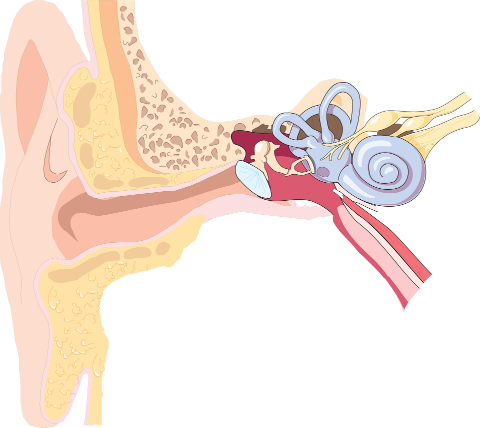
Researchers find target to protect hearing during chemotherapy treatment.
Scientists have found a new way to explain the hearing loss caused by cisplatin, a powerful drug used to treat many forms of cancer. Using a highly sensitive technique to measure and map cisplatin in mouse and human inner ear tissues, researchers found that forms of cisplatin build up in the inner ear. They also found a region in the inner ear that could be targeted for efforts to prevent hearing loss from cisplatin.
Cisplatin and similar platinum-based drugs are prescribed for an estimated 10-20% of all cancer patients. The NIH’s National Cancer Institute supported research that led to the 1965 discovery of cisplatin and continued development leading to its success as an essential weapon in the battle against cancer. The drugs cause permanent hearing loss in 40-80% of adult patients and at least half of children who receive the drug. The new findings help explain why cisplatin is so toxic to the inner ear, and why hearing loss gets worse after each treatment, can occur long after treatment, and is more severe in children than adults.
In most areas of the body, cisplatin is eliminated within days or weeks after treatment, but in the inner ear, the drug remains much longer. Previous research focused on why the inner ear is more sensitive than other parts of the body to cisplatin-induced damage. The NIH team pursued a new angle on the problem: What if the inner ear is not able to get rid of cisplatin, and cells in the inner ear important for hearing die because they are exposed to the drug for a long time?
The team developed a mouse model that represents cisplatin-induced hearing loss seen in human patients. By looking at inner ear tissue of mice after the first, second, and third cisplatin treatment, researchers saw that cisplatin remained in the mouse inner ear much longer than in most other body tissues, and that it builds up with each successive treatment. They also studied inner ear tissue donated by deceased adult patients who had been treated with cisplatin, and observed that cisplatin is retained in the inner ear many months or years after treatment. In addition, when they examined inner ear tissue from one child, they found cisplatin buildup that was even higher than seen in adults. These results suggest that the inner ear readily takes up cisplatin, but it has very little ability to remove the drug.
In mice and human tissues, the research team saw the highest buildup of cisplatin in a part of the inner ear called the stria vascularis, which helps maintain the positive electrical charge in inner ear fluid that certain cells need to detect sound. The research team determined that the accumulation of cisplatin in the stria vascularis portion of the inner ear contributed to cisplatin-related hearing loss.
“Our findings suggest that if we can prevent cisplatin from entering the stria vascularis in the inner ear during treatment, we may be able to protect cancer patients from developing cisplatin-induced hearing loss,” said Cunningham.
The study, published in Nature Communications), was supported by the National Institute on Deafness and other Communications Disorders (NIDCD), part of the National Institutes of Health.
Lisa L. Cunningham, chief of the NIDCD Section on Sensory Cell Biology, led the research team, which included scientists from the National Institute on Minority Health and Health Disparities (NIMHD) and the National Center for Advancing Translational Sciences (NCATS). Support for data analysis was provided by Electro Scientific Industries of Bozeman, Montana.
Related News
-

News GSK announces £400 million investment in new Cambridge R&D centre
Pharmaceutical giant to establish flagship research facility on Cambridge Biomedical Campus as part of strategic pipeline acceleration
-

News Understanding the Benefits and Advances of Cleanroom Technology
In an industry where precision and sterility are crucial concerns, cleanrooms play a vital role in maintaining the integrity of pharmaceutical products like drugs, vaccines, and other medical products. So, what is a cleanroom?
-

News AbbVie secures GBP£1.2 billion deal for Gilgamesh’s psychedelic programme
AbbVie has penned a significant agreement to acquire the bretisilocin programme from Gilgamesh Pharmaceuticals for up to £1.2 billion, marking a bold step in the pharmaceutical giant's quest to develop treatments for psychiatric disorders. -

News Gates Foundation commits US$2.5 billion to women’s health research
The Bill & Melinda Gates Foundation has announced a substantial US$2.5 billion commitment to accelerate research and development focused exclusively on women's health through 2030.
-

News Mid-year review: notable FDA drug approvals of 2025
As we fly past the halfway point of 2025, the pharmaceutical landscape reliably continues to evolve with innovative therapies addressing critical medical needs. The FDA has already approved 17 groundbreaking medications this year, each representin... -

News US FDA announces new priority vouchers for accelerated review times
The US FDA announced a new priority program for drug developers – the Commissioner’s National Priority Voucher (CNPV) program aims to enhance the health interests of the US by allowing drug developers to redeem a voucher, shortening th... -
News Google-backed start-up raises US$600 million to support AI drug discovery and design
London-based Isomorphic Labs, an AI-driven drug design and development start-up backed by Google’s AI research lab DeepMind, has raised US$600 million in its first external funding round by Thrive Capital. The funding will provide further power t... -

News AstraZeneca to invest US$2.5 billion in Beijing R&D centre
Amid investigations of former AstraZeneca China head Leon Wang in 2024, AstraZeneca have outlined plans to establish its sixth global strategic R&D centre in China. Their aim is to further advance life sciences in China with major research and manufact...