
Novel Organoid Matrix Enables Long-Term Culture of Human Hepatocytes
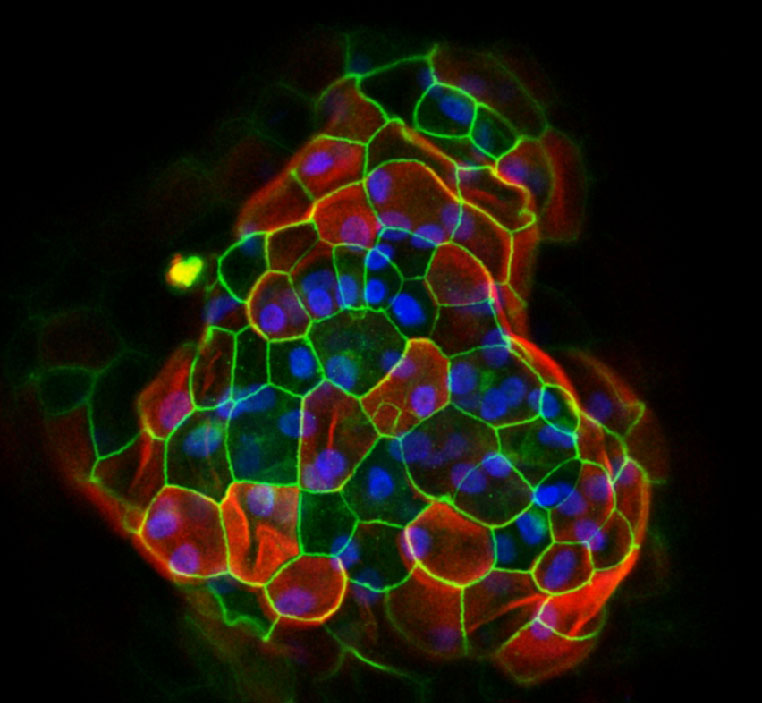
AMSBIO reports on the recent publication in Cell by Dr Meritxell Huch, Prof Hans Clevers et al. of ground-breaking research using Cultrex BME2 reduced growth factor (organoid growth matrix) to enable long-term (>1 year) culture of genome-stable bipotent stem cells from adult human liver. These results open up new experimental avenues towards the use of human liver material expanded in vitro as an alternative cell source for disease modeling, toxicology studies, drug testing, regenerative medicine and gene therapy.
Liver diseases (ranging from genetic inherited disorders to viral hepatitis, liver cancer, and obesity-related fatty liver disease) are the twelfth-leading cause of death in the US. Failure in the management of liver diseases can be attributed to the shortage of donor livers as well as to our poor understanding of the mechanisms behind liver pathology. The value of any cultured cell as a disease model or as a source for cell therapy transplantation depends on the fidelity and robustness of its expansion potential as well as its ability to maintain a normal genetic and epigenetic status.
The research by Huch, Clevers et al. shows that primary human bile duct cells can readily be expanded in vitro as bipotent stem cells into 3D liver organoids using AMSBIO’s reduced growth factor basement membrane extract Cultrex BME2 as extracellular matrix (ECM). In this novel culture system, adult liver stem cells maintain their ability of self-renewal; differentiating into functional hepatocyte cells in vitro and generating bona fide hepatocytes upon transplantation. Extensive analysis of the genetic stability of cultured organoids in vitro demonstrates that the expanded cells preserve their genetic integrity over months in culture (agreeing with the authors’ previous observations in a mouse model). Organoids derived from patients with genetic disorders can be used to model liver disease in vitro.
Commenting on this research, Dr Huch said “We have obtained culture conditions that allow us to long-term expand genetically stable human donor liver cells in organoid culture. One of the clues to this success is the use of ECM that allows the cells to grow in 3D. BME2 has been our ECM of choice for these experiments.”
AMSBIO has been working with the variability of the cellular microenvironment and how it affects the physiological relevance of cell culture. Factors contributing to this variability include: organ specific stromal cells, growth factors, proteoglycan and protein composition, and stiffness or tensile strength of the basement membrane extract or extracellular matrix. Matrices from AMSBIO not only support cells and cell layers, but also play an essential role in tissue organization that affects cell adhesion, migration, proliferation, and differentiation. These aspects can be studied with kits from AMSBIO incorporating their wealth of experience in this area. Cultrex Basement Membrane Extract (BME) is a soluble form of basement membrane purified from Engelbreth-Holm-Swarm (EHS) tumour. The extract gels at 37 °C to form a reconstituted basement membrane. Major components of BME include laminin, collagen IV, entactin, and heparan sulfate proteoglycan. These extracted proteins can be used in multiple applications, under a variety of cell culture conditions, for maintaining growth or promoting differentiation of primary endothelial, epithelial, smooth muscle and stem cells. BME can also be utilized in cell attachment, neurite outgrowth, angiogenesis, in vitro cell invasion and in vivo tumorigenicity assays. The new BME 2 is a proprietary formulation that has a higher tensile strength than similar products such as Matrigel.
Related News
-

News GSK announces £400 million investment in new Cambridge R&D centre
Pharmaceutical giant to establish flagship research facility on Cambridge Biomedical Campus as part of strategic pipeline acceleration
-
News Understanding the Benefits and Advances of Cleanroom Technology
In an industry where precision and sterility are crucial concerns, cleanrooms play a vital role in maintaining the integrity of pharmaceutical products like drugs, vaccines, and other medical products. So, what is a cleanroom?
-
News AbbVie secures GBP£1.2 billion deal for Gilgamesh’s psychedelic programme
AbbVie has penned a significant agreement to acquire the bretisilocin programme from Gilgamesh Pharmaceuticals for up to £1.2 billion, marking a bold step in the pharmaceutical giant's quest to develop treatments for psychiatric disorders. -
News Gates Foundation commits US$2.5 billion to women’s health research
The Bill & Melinda Gates Foundation has announced a substantial US$2.5 billion commitment to accelerate research and development focused exclusively on women's health through 2030.
-

News Mid-year review: notable FDA drug approvals of 2025
As we fly past the halfway point of 2025, the pharmaceutical landscape reliably continues to evolve with innovative therapies addressing critical medical needs. The FDA has already approved 17 groundbreaking medications this year, each representin... -

News US FDA announces new priority vouchers for accelerated review times
The US FDA announced a new priority program for drug developers – the Commissioner’s National Priority Voucher (CNPV) program aims to enhance the health interests of the US by allowing drug developers to redeem a voucher, shortening th... -
News Google-backed start-up raises US$600 million to support AI drug discovery and design
London-based Isomorphic Labs, an AI-driven drug design and development start-up backed by Google’s AI research lab DeepMind, has raised US$600 million in its first external funding round by Thrive Capital. The funding will provide further power t... -
News AstraZeneca to invest US$2.5 billion in Beijing R&D centre
Amid investigations of former AstraZeneca China head Leon Wang in 2024, AstraZeneca have outlined plans to establish its sixth global strategic R&D centre in China. Their aim is to further advance life sciences in China with major research and manufact...