
PSCI launches progressive position on the use of Horseshoe Crabs
A quarterly series of articles about responsible supply chain management from the PSCI.
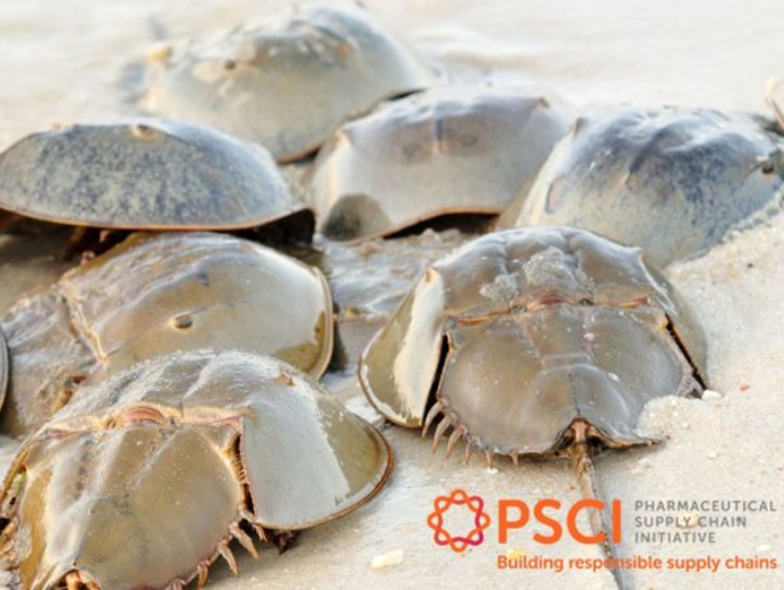
Horseshoe Crabs are an ancient group of crab species that have been around for more than 400 million years. Their blood has the remarkable property of indicating certain types of endotoxins.
For this reason, it has been harvested by the medical and pharma industries to use as a test for these harmful compounds. Endotoxin testing using approved methods is a key demand of the regulators who authorise pharmaceutical development and manufacturing.
While this process does not require the death of the animal, there are still questions over possible animal welfare, biodiversity, and sustainability impacts from the collection of these materials from populations of wild crabs. Of the three affected species of Horseshoe Crabs across the USA and Asia, one Asian species is listed as endangered, with concerns over the other Asian species where data is deficient.
The connection between the Horseshoe Crab species and the pharmaceutical sector does highlight the importance of biodiversity for human health and acts an excellent example of interdependence between medicine and biodiversity. It also illustrates the complexity of biodiversity-related sourcing in a regulated industry.
However, it also emphasizes the need for the industry to take an active position, and so the Pharmaceutical Supply Chain Initiative (PSCI) has launched our progressive position paper on what we believe to be good practice for the use of Horseshoe Crab blood within the pharmaceutical industry.
“The PSCI is releasing this position paper to encourage our members to protect the endangered species, seek out alternatives to these materials, and to adopt an intentional approach to sourcing where it remains necessary. Our commitment is to work together now, to drive this transition towards a long-term sustainable position and to play our part in protecting these remarkable species.”
– A spokesperson for the PSCI.
Representing 75 of the world’s largest pharmaceutical companies, the PSCI will encourage its members to commit to no further collection from endangered species, minimising the use of these materials, and sharing information to understand the surrounding animal welfare and conservation questions.
While this paper is not a membership requirement for the PSCI, it does outline the organisation’s views on good practice as it continues its commitment to the protection of all endangered species. It is important the industry has a strategy for reducing its dependence on Horseshoe Crab-derived products, and the PSCI is committed to working with its members to facilitate their progress and report the position across the whole industry.
Read more via the button below.
Related News
-

News Understanding the Benefits and Advances of Cleanroom Technology
In an industry where precision and sterility are crucial concerns, cleanrooms play a vital role in maintaining the integrity of pharmaceutical products like drugs, vaccines, and other medical products. So, what is a cleanroom?
-

News AbbVie secures GBP£1.2 billion deal for Gilgamesh’s psychedelic programme
AbbVie has penned a significant agreement to acquire the bretisilocin programme from Gilgamesh Pharmaceuticals for up to £1.2 billion, marking a bold step in the pharmaceutical giant's quest to develop treatments for psychiatric disorders. -

News Gates Foundation commits US$2.5 billion to women’s health research
The Bill & Melinda Gates Foundation has announced a substantial US$2.5 billion commitment to accelerate research and development focused exclusively on women's health through 2030.
-

News Mid-year review: notable FDA drug approvals of 2025
As we fly past the halfway point of 2025, the pharmaceutical landscape reliably continues to evolve with innovative therapies addressing critical medical needs. The FDA has already approved 17 groundbreaking medications this year, each representin... -

News US FDA announces new priority vouchers for accelerated review times
The US FDA announced a new priority program for drug developers – the Commissioner’s National Priority Voucher (CNPV) program aims to enhance the health interests of the US by allowing drug developers to redeem a voucher, shortening th... -

News Google-backed start-up raises US$600 million to support AI drug discovery and design
London-based Isomorphic Labs, an AI-driven drug design and development start-up backed by Google’s AI research lab DeepMind, has raised US$600 million in its first external funding round by Thrive Capital. The funding will provide further power t... -

News AstraZeneca to invest US$2.5 billion in Beijing R&D centre
Amid investigations of former AstraZeneca China head Leon Wang in 2024, AstraZeneca have outlined plans to establish its sixth global strategic R&D centre in China. Their aim is to further advance life sciences in China with major research and manufact... -
News Experimental drug for managing aortic valve stenosis shows promise
The new small molecule drug ataciguat is garnering attention for its potential to manage aortic valve stenosis, which may prevent the need for surgery and significantly improve patient experience.