
Takeda Ireland introduces digital pharma operations
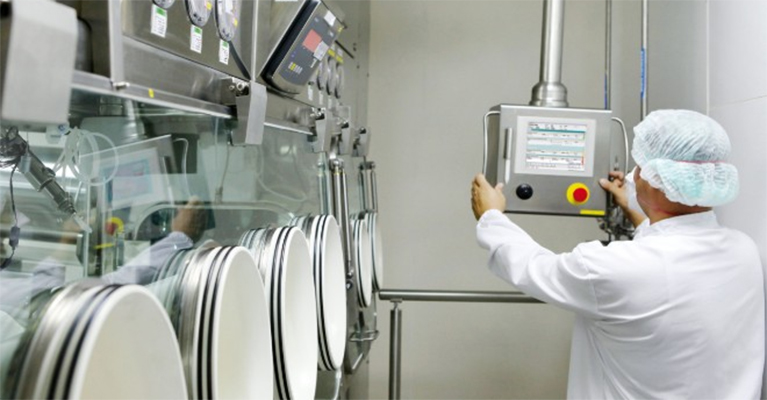
PAS-X operator.
Successful transformation to paperless factory brings huge benefits in quality, regulatory compliance, operations and data availability.
Takeda Ireland has implemented Werum’s PAS-X Manufacturing Execution System (MES) in a phased approach at its Grange Castle, Ireland, production site.
“With the help of Werum’s PAS-X MES we were able to successfully transform our Grange Castle site into a paperless factory,” says Paul Keogh, Plant Director at Takeda Ireland Limited Grange Castle. “The new digital operations provide huge quality, regulatory, operational, and data availability benefits. Example benefits include work standardization, human error avoidance, data entry reduction, batch review by exception, manufacturing decision support, material management, data visualization, etc. Moreover, the MES-based Level 2-4 integration architecture provides a solid platform for digital innovation and operational expansion.”
Werum’s PAS-X MES automatically pulls manufacturing data from the shop floor by integrating Takeda’s Process Control System via OSIsoft PI Historian. Thus, approximately 94% of all parameters in each batch record are automatically entered to the batch record. MES is configured to download recipes to the process control layer and to synchronize Electronic Batch Recording (EBR) with process controls in real-time to ensure batch data entry is contemporaneous and original as production progresses. In addition to the basic data integrity benefits, PAS-X EBR enforces additional operator confirmations and electronic signatures where required based on GxP and safety risks. Through EBR the manufacturing process is highly standardized, and batch review by exception is supported.
In addition to the shop floor integration, new PAS-X SAP interfaces were developed during the Takeda Ireland project as part of a global SAP template rollout across Takeda. These interfaces enable a seamless exchange between the global supply chain and the local manufacturing execution process.
The integrated MES template provides a basis for MES expansion to support operations for two new innovative manufacturing plants currently under construction at the Takeda Ireland Grange Castle campus. The new plants are solid oral dose and liquid vial based drug products employing high containment and cell culture technologies respectively.
Related News
-
.png)
News Protecting life-saving therapies: CPHI Online Podcast Series
The latest episode of the CPHI Podcast Series dives into a critical challenge facing the pharmaceutical industry: ensuring the integrity of temperature-sensitive medications and biologics through advanced predictive technology.
-
News Boehringer Ingelheim to invest in new AI Accelerator in London
Boehringer Ingelheim has unveiled a cutting-edge AI Accelerator in London’s Knowledge Quarter, marking a significant step in computational innovation and the future of pharmaceutical research.
-

News Amazon Bio Discovery launched to accelerate AI-powered drug discovery
Amazon Web Services (AWS) has introduced Amazon Bio Discovery, a new platform designed to harness AI in the field of drug discovery. The initiative aims to address the challenges of lengthy and expensive drug development processes by providing research... -
News AI-powered therapy offers hope for rare familial polyposis
Recursion Pharmaceuticals has announced promising results from its ongoing early- to mid-stage trial evaluating its AI-powered treatment, REC-4881, for familial adenomatous polyposis (FAP).
-
News CPHI Podcast Series: AI transforming pharma manufacturing
This episode explores how AI is revolutionising the pharmaceutical industry, from "smart factories" to seamless supply chain integration, and discuss the transformative advancements shaping the next decade.
-

News AstraZeneca invests in AI-led research agreement with China's CSPC, up to US$5.3 billion
Anglo-Swedish pharmaceutical giant AstraZeneca announced they have signed a deal with China’s CSPC Pharmaceutical Group worth up to US$5.3 billion to drive AI-led research development of therapies for chronic conditions.
-
News Google-backed start-up raises US$600 million to support AI drug discovery and design
London-based Isomorphic Labs, an AI-driven drug design and development start-up backed by Google’s AI research lab DeepMind, has raised US$600 million in its first external funding round by Thrive Capital. The funding will provide further power t... -

News How GLP-1 agonists are reshaping drug delivery innovations
GLP-1 agonist drug products like Ozempic, Wegovy, and Mounjaro have taken the healthcare industry by storm in recent years. Originally conceived as treatment for Type 2 diabetes, the weight-loss effects of these products have taken on unprecedented int...