
The PSCI publishes Materiality Assessment of the Pharma Supply Chain
.png)
In the latest instalment of the PSCI blog on CPHI Online, The PSCI introduces the 2024 PSCI Supply Chain Materiality Assessment, the first public materialty assessment of the pharmaceutical supply chain they have worked on.
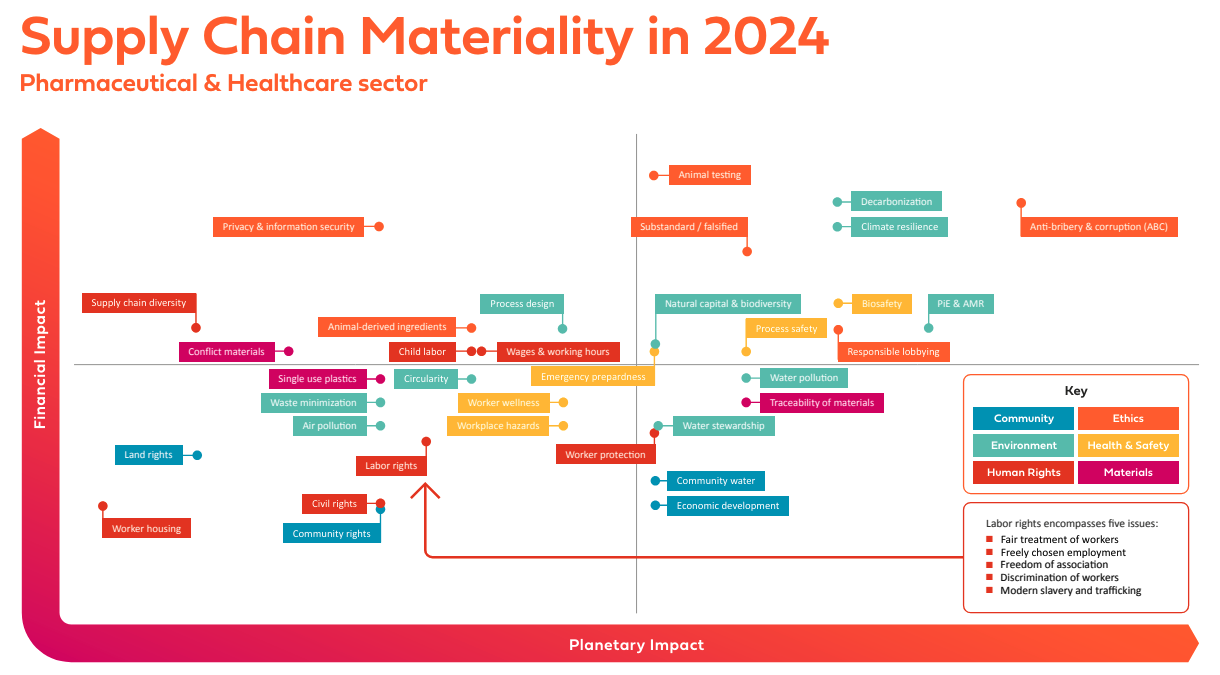
The 2024 PSCI Supply Chain Materiality Assessment focused on supply chains for the Pharmaceutical and Healthcare industries, taking into account the views of its own members, as well as a range of sources from outside the PSCI.
These assessments are conducted periodically by the PSCI, but this year the association decided to apply a double materiality approach, based on the methodology published by the European Financial Reporting Group (EFRAG), that scores issues against two categories: business or financial impacts, and planetary impacts.
The assessment results contain a number of key findings divided into six categories: ethics, human rights, health & safety, environment, materials, and community.
There are several notable new inclusions this year, including:
Ethics: responsible engagement on policy (lobbying) & substandard and falsified medicines
Human Rights: diversity and inclusion & housing conditions
Health & Safety: workplace hazards & biosafety
Environment: climate change resilience
Materials: traceability of raw materials
Community: communities’ human rights
Reflecting on the assessment, PSCI Chair & Global EH&S Supplier Operations and Business Development Lead at Viatris, Dr Deirdre O’Reilly, said:
“New regulations and investor demands are raising the bar for company reporting on supply chain responsibility. This year's assessment highlights the growing importance of robust supply chain programmes, encompassing a wider range of issues. It also reflects the changing nature of the industry’s products and markets.”
The assessment is intended to represent the sector as a whole, and is not reflective of each individual company. Pharma is a diverse industry and material issues for individual businesses will differ depending on a variety of factors like product mix, geography, ownership, etc. A full double materiality review would typically include rigorous quantification of impacts. As this is challenging to do at a sector level, this assessment from the PSCI used desk research along with member inputs to score issues using a framework aligned with EFRAG’s double materiality guidance.
Research resources for the assessment included:
- The latest legislation, reporting frameworks, and investor indices;
- Media reports, NGO activity, and other relevant reports and research;
- External stakeholder input including PSCI’s advisory panel and other partner organisations;
Finally, another vital part of the process was member inputs. These inputs came through ongoing and regular discussions within the PSCI’s own topic teams, as well as through the 2023 member consultation across all PSCI Principles topics. Throughout the assessment and scoring, a patient lens was applied, considering how patients could be impacted by substantially positive or negative handling of each issue.
The PSCI intends to use the results of this assessment to ensure that new and emerging topics are considered (and top issues given due focus in their activities), that the position of important stakeholders on supply chain responsibility topics is systematically understood, and finally that PSCI members’ responsibility programmes are covering all material issues.
For the 2024 PSCI Supply Chain Materiality Assessment, click here.
Related News
-

News Understanding the Benefits and Advances of Cleanroom Technology
In an industry where precision and sterility are crucial concerns, cleanrooms play a vital role in maintaining the integrity of pharmaceutical products like drugs, vaccines, and other medical products. So, what is a cleanroom?
-

News Women in Pharma: The Final Chapter of 2025
Our monthly Women in Pharma series highlights the influential lives and work of impactful women working across the pharmaceutical industry, and how the industry can work towards making the healthcare industry and workplace more equitable and ... -

News Introducing the Pharmaceutical Sustainability Ecosystem from CPHI
The Sustainability Collective from CPHI unveils the groundbreaking Pharmaceutical Sustainability Ecosystem to drive pharmaceutical knowledge sharing, connection, and collaboration in order to change the face of sustainability in pharmceutical... -

News Navigating Cross-Border Pharmaceutical Logistics: Strategies for a More Resilient Supply Chain
This is a feature article written by Nick Fryer, Vice President of Marketing, Sheer Logistics
-

News A Day in the Life of a Director of Business Development
In this Day in the Life of interview, Thomas Hauser, Director of Business Development at Tjoapack. Thomas has spent nearly 30 years in the pharmaceutical industry and describes how he still finds curiosity and excitement in the bigger picture of global... -

News PhRMA trade association issues comments on Section 232 investigation
The Pharmaceutical Research and Manufacturers of America (PhRMA), an American trade association representing groups in the pharmaceutical industry, issued a letter on May 6, 2026 to the Department of Commerce regarding the Section 232 National Security... -

News Pharmaceutical Packaging Market Prospects: Shifting regional policies
The pharmaceutical packaging industry is experiencing significant transformation in 2025, driven by regulatory changes, supply chain challenges, and sustainability initiatives. The US BIOSECURE Act, passed through the House of Representatives in Septem... -

News Say hello to the CPHI Exhibitor Spotlight!
We’re kicking off a brand-new series where we shine the spotlight on some of the amazing companies gearing up to shake things up at CPHI Americas 2025 this May! The first company in our spotlight is TAPI, who are set to make a splash at its ve...