
Amgen breaks ground on next-generation biomanufacturing plant in Rhode Island
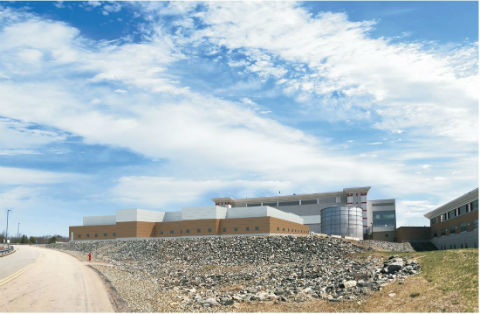
Rendering of new next-generation biomanufacturing plant.
The plant will be first-of-its-kind in the US.
Amgen has announced the groundbreaking of its new next-generation biomanufacturing plant that will be constructed at its West Greenwich, R.I. campus. The new plant is the first-of-its-kind in the US and will use Amgen's proven next-generation biomanufacturing capabilities to manufacture products for the US and global markets.
"Biologics manufacturing is a complex science and has long been a competitive advantage for Amgen," said Robert A. Bradway, chairman and chief executive officer at Amgen. "We are working to extend that advantage even further with a next-generation biomanufacturing plant in Rhode Island that will produce medicines to serve patients around the world suffering from serious illnesses."
A next-generation biomanufacturing plant incorporates multiple innovative technologies into a single facility, and therefore is built in half the construction time with approximately one half of the operating cost of a traditional plant. Next-generation biomanufacturing plants require a smaller manufacturing footprint and offer greater environmental benefits, including reduced consumption of water and energy and lower levels of carbon emissions. Within the plant, the equipment is portable, smaller and some components are disposable, which provides greater flexibility and speed when manufacturing different medicines simultaneously. This eliminates costly and complex retrofitting inherent in standard facilities and allows Amgen to respond to changing demands for its medicines with increased agility, ultimately impacting the speed at which a medicine is available for patients.
"We are thrilled that Amgen has selected Rhode Island as the location for this plant that will be the first-of-its-kind in the United States," said Governor Gina M. Raimondo. "This is more proof that Rhode Island is now successfully competing for economic development opportunities with global companies thanks to our highly skilled workforce, robust academic institutions and exceptional quality of life. Rhode Island is proud to support Amgen in its commitment to developing innovative medicines."
Amgen expects to invest up to $200 million in the approximately 120,000 square foot next-generation manufacturing plant in Rhode Island. This plant is anticipated to create approximately 150 additional highly-skilled manufacturing positions.
"Since its inception in 2002, Amgen Rhode Island has evolved to a multi-product manufacturing facility, which is a testament to our focus on innovation, technology and great staff," said Tia Bush, vice president of Operations at Amgen Rhode Island. "Constructing this next-generation plant in Rhode Island further enhances our manufacturing capabilities within Amgen's global operations network to deliver on our mission to serve patients."
The existing Amgen Rhode Island plant was licensed by the U.S. Food and Drug Administration in September 2005 and houses one of the world's largest mammalian protein manufacturing facilities. The facility manufactures commercial and clinical bulk drug substance. Amgen has invested more than $1.5 billion in its Rhode Island campus, adding more than 500,000 square feet of manufacturing, utility, administrative and laboratory space to the campus. There are approximately 625 full-time staff members employed at the Amgen Rhode Island campus.
Related News
-
News Novartis signs US$3.2 bn subcutaneous delivery deal with Alteogen
Swiss pharma giant secures access to Korean biotech's ALT-B4 hyaluronidase platform in milestone-heavy agreement, marking Alteogen's fourth major licensing deal of 2026 as competition intensifies in the subcutaneous drug delivery space.
-

News Women in Pharma: The philosophy of pharmaceutical leadership
In this latest instalment of our Women in Pharma series, we sit down with Clarissa Sowemimo-Coker, Chief Strategy Officer at Ambrose Healthcare and CPHI Middle East Advisory Board Member.
-
News The PSCI Supplier Partnership - Collaboration for Responsible Supply Chains
About the Pharmaceutical Supply Chain Initiative The Pharmaceutical Supply Chain Initiative (PSCI) is the leading, member-led association for pharmaceutical companies working collaboratively to build responsible supply chains. Founded in 2006 and es... -
News AstraZeneca shares plunge 8.9% after reports of BMS talks
Britain's largest drugmaker lost more than GBP£17 billion in market value following reports of preliminary merger discussions with Bristol Myers Squibb that could create a pharmaceutical giant worth nearly US$400 billion, though investors rem... -
News GSK announces £400 million investment in new Cambridge R&D centre
Pharmaceutical giant to establish flagship research facility on Cambridge Biomedical Campus as part of strategic pipeline acceleration
-

News The CPHI Sustainability Summit - Where Conversation Becomes Collaboration
The Report Was Never the Destination - “The future of pharmaceutical sustainability won’t be shaped by individual organisations working in isolation. It will be shaped by partnerships, shared expertise and the willingness to work diffe... -

News Trump's generic drug tariffs set to reshape global pharmaceutical supply chains
The US president has announced plans to impose tariffs of up to 200% on imported generic medicines from August 2028, giving manufacturers a two-year window to establish domestic production facilities. The move threatens to upend a global supply chain t... -

News Building Safer, More Responsible Pharmaceutical Supply Chains: PSCI Global Audit Insights
The Pharmaceutical Supply Chain Initiative (PSCI) has released its seventh annual Audit Findings Analysis Report, offering unprecedented insights into supplier practices across the global pharmaceutical and healthcare industry.With a record-breaking 24...