
Beyond the platform – applying modularity to autoinjector development
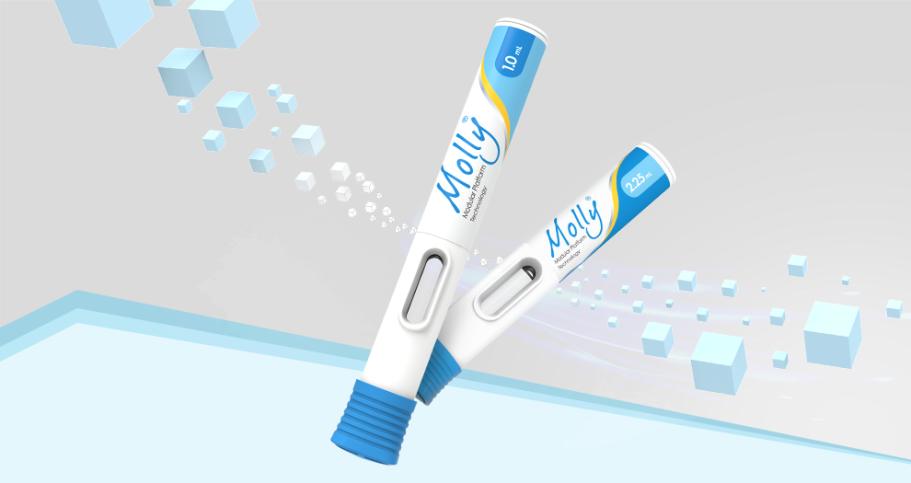
SHL’s Molly® and Molly® 2.25 mL autoinjectors are built upon a proven modular platform technology to support shorter development timelines and increased flexibility in device design and production.
Injectable drug delivery systems have become an important and integral part of modern medicine, owing to various key drivers such as human health and well-being, drug development and delivery, as well as patient safety and usability. Injectable therapy has at the same time been met with an increased focus on self-administration, mainly due to the added benefit of patient convenience, but also due to the growing pipeline of biological and biosimilars drugs.
For the past decade, preconfigured or platform self-injection devices such as autoinjectors have been heavily sought after by medical device developers due to their ability to meet the pharma and biopharmaceutical industry’s need to take their drugs to clinic and to market at comparatively shorter timelines and lower costs. Despite these advantages, conventional platforms do have some disadvantages. For instance, a clear-cut trade-off for fast development time entwined with platform devices is the loss or diminishing level of flexibility to device customizations, whether it be in accordance with the customer, primary container, branding, or patient requirements. Yet with the rising need for products to offer design differentiation for brand and usability requirements, devices are increasingly expected to offer flexibility beyond the confinements of a platform product.
This is where the addition of modularity is key.
The concept of modularity stems from the general attempt to operationalize and understand complex systems. In a modular platform, the product is divided into modules that can be swapped with other elements of different sizes or functionality to create variants.1 Asset flexibility, cost of goods, and investment deferment are just some of the key drivers behind modular systems.2 When done correctly, modularity supports standardization, repeatability, as well as customization.
In autoinjector development, this translates into the opportunity to leverage all the advantages of a traditional platform device technology while still allowing for various customizations in the device’s design and development. The result is a flexible platform – or a modular platform – that can meet the requirements for industrial design customization and production scaling. In other words, modularity offers double competitiveness to organizations in the form of product cost-effectiveness and freedom of customization.
SHL Medical’s Molly® and Molly® 2.25 mL autoinjectors are built upon a modular platform technology that supports this duality in standardization and customization. First introduced in 2010, the Molly® platform has supported the development and regulatory approval of 17 combination products around the world.3 And it is upon these successes and wealth of experience that Molly®’s modularity is established.
Molly®’s technology is modular in that both the front and rear sub-assemblies comprise intricately designed parts that are configured to allow for an appreciable level of freedom for customization while maintaining its core drug delivery mechanism. For instance, in addition to changing the color of the cap, needle cover, and plunger rod, industrial design customizations in the device’s body and cap are also possible. This allows pharmaceutical companies to introduce unique designs not only for branding and market differentiation, but also for patient distinguishability and usability. Compared to creating a completely bespoke autoinjector, customizing an established platform supports the simplification of project processes and optimization of timelines4.
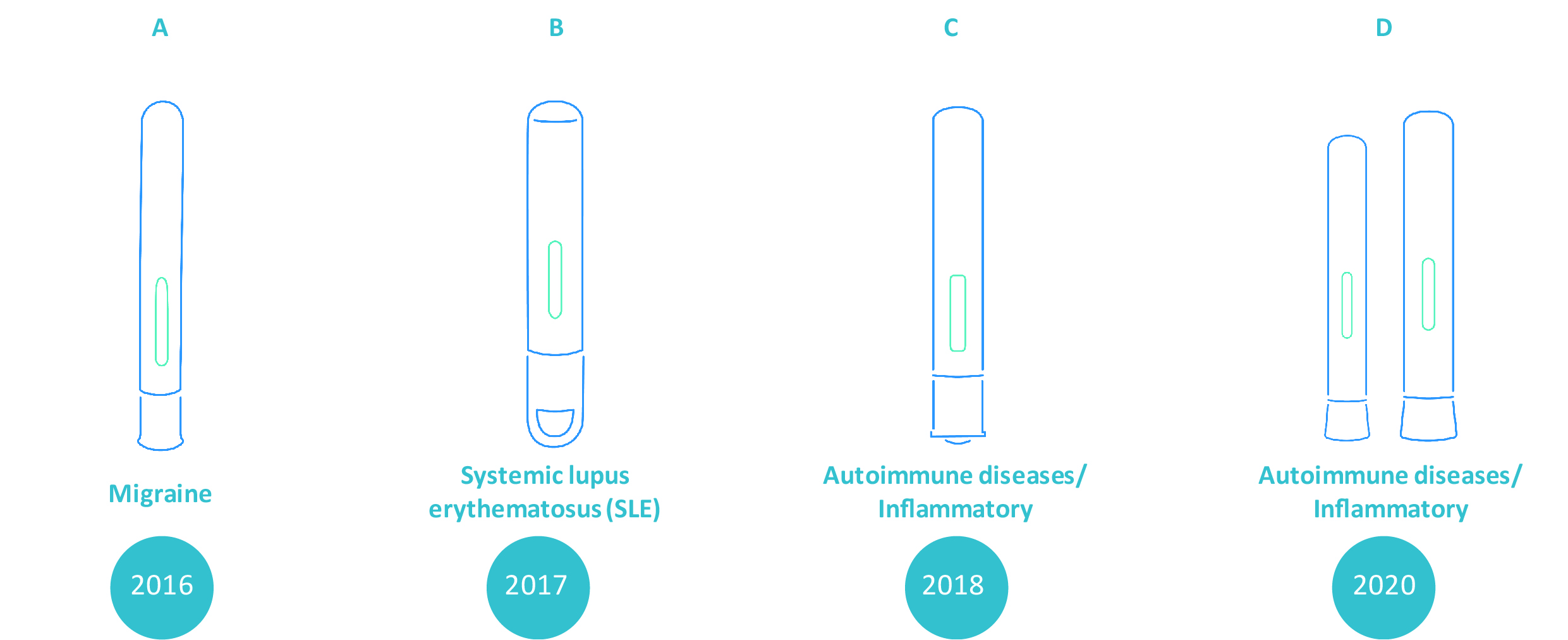
Examples of commercialized Molly® projects with various levels of design customization
For device projects based on the Molly® technology, modularization is not only applied to the device design, but also to the development infrastructures that support it. For example, SHL’s automated assembly and testing equipment platforms also utilize modular infrastructures that can be adjusted to process a mix of different Molly® designs – or several versions of the same Molly® design – at speed, on a flexible scale, and with consistent quality. This complementation ensures that customizations in the device design can be assembled and tested through common machines that feature interchangeable tools and stations corresponding to the device’s characteristics. Moreover, by reusing much of the machinery to assemble and/or test different injection devices, emissions from producing and operating individual pieces of machinery are reduced, increasing the overall sustainability of the final product.
Molly®’s customer-focused model has made it SHL’s most versatile offering to date. Molly® is currently supporting around 14 molecular entities approved for a range of disease areas. This includes one of the world’s first regulatory approved autoinjectors in the high-volume (≥ 2.0 mL) range, as well as a recent combination product addressing obesity. But the true value of Molly® lies in its flexible design and development model that will continue to scale in response to industry advances, such as in data science and future device add-ons that live within a reformulated digital health ecosystem.
For more information on the Molly modular platform technology, please visit the Molly® website
References:
- Zha XF, Sriram RD, “Platform-Based Product Design and Development: A Knowledge-Intensive Support Approach.” Knowledge-Based Systems, vol. 19, no. 7, pp. 524–543, 2006.
- Hernandez R, "Modular Manufacturing Platforms for Biologics". BioPharm International, 28 (5), 2015.
- Internal data as of July 2021.
- Wild L, Fuensalida Pantig GR, “The “Customisable Platform” Paradox”. ONdrugDelivery, Issue 113 (Oct 2020), pp 80–85.
.jpg)
Related News
-

News Understanding the Benefits and Advances of Cleanroom Technology
In an industry where precision and sterility are crucial concerns, cleanrooms play a vital role in maintaining the integrity of pharmaceutical products like drugs, vaccines, and other medical products. So, what is a cleanroom?
-

News Women in Pharma: The Final Chapter of 2025
Our monthly Women in Pharma series highlights the influential lives and work of impactful women working across the pharmaceutical industry, and how the industry can work towards making the healthcare industry and workplace more equitable and ... -

News Introducing the Pharmaceutical Sustainability Ecosystem from CPHI
The Sustainability Collective from CPHI unveils the groundbreaking Pharmaceutical Sustainability Ecosystem to drive pharmaceutical knowledge sharing, connection, and collaboration in order to change the face of sustainability in pharmceutical... -
News Navigating Cross-Border Pharmaceutical Logistics: Strategies for a More Resilient Supply Chain
This is a feature article written by Nick Fryer, Vice President of Marketing, Sheer Logistics
-

News A Day in the Life of a Director of Business Development
In this Day in the Life of interview, Thomas Hauser, Director of Business Development at Tjoapack. Thomas has spent nearly 30 years in the pharmaceutical industry and describes how he still finds curiosity and excitement in the bigger picture of global... -

News PhRMA trade association issues comments on Section 232 investigation
The Pharmaceutical Research and Manufacturers of America (PhRMA), an American trade association representing groups in the pharmaceutical industry, issued a letter on May 6, 2026 to the Department of Commerce regarding the Section 232 National Security... -

News Pharmaceutical Packaging Market Prospects: Shifting regional policies
The pharmaceutical packaging industry is experiencing significant transformation in 2025, driven by regulatory changes, supply chain challenges, and sustainability initiatives. The US BIOSECURE Act, passed through the House of Representatives in Septem... -

News Say hello to the CPHI Exhibitor Spotlight!
We’re kicking off a brand-new series where we shine the spotlight on some of the amazing companies gearing up to shake things up at CPHI Americas 2025 this May! The first company in our spotlight is TAPI, who are set to make a splash at its ve...