
Bio processing and manufacturing league table ranks US top and China bottom
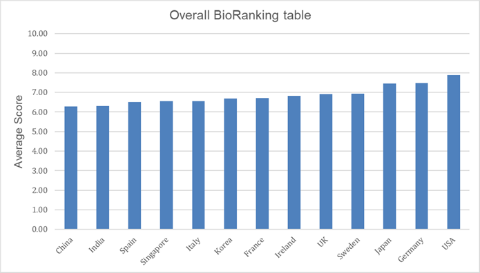
US, Germany and Japan revealed as tier one nations in all categories with Sweden ranking the best of the rest.
bioLIVE – the new bioprocessing and manufacturing event running alongside this year’s CPHI Worldwide – announces the initial findings of the world’s first ever biopharma league table, which evaluates the reputations of major bio manufacturing countries across a number of characteristics (scored 1-10). This follows the launch of the small molecule pharma league table introduced last year.
Most surprising are the results of China – a nation that has seen a well-documented surge in both innovative biotech start-ups and bioprocessing and manufacturing companies – whose reputation in biologics is still far behind the more established players. China scored below 6 for ‘bio innovation’ and ‘quality of biological manufacturing’ – bottom in both respective league tables – suggesting perception here may lag behind reality.
bioLIVE expert, Dawn M. Ecker of BioProcess Technology Consultants, commented: “If we look at quality and innovation – both important attributes for advancing bioprocessing technologies – the US, Germany and Japan are ranked highest, followed by several other European countries, where biomanufacturing is a mature industry. China and India, both burgeoning markets for biologics, were not ranked as high for innovation. This perception may relate to the still developing biologics and bioprocessing industry in these regions, coupled with the knowledge of their existing reputations for mass production of generics.”
The full findings from 500 companies will be announced during bioLIVE in Madrid (October 9-11, 2018), with host nation Spain scoring just above 6 for all categories – significantly behind the other four major EU economies, as well as Ireland. In fact, recent training initiatives by Ireland’s NIBRT (National Institute for Bioprocessing Research) may be paying dividends as the country scored highly on ‘knowledge of bio professionals’ (7.2), and second only to Germany in terms of ‘growth potential’ (7.0) amongst EU countries.
Ecker, however, felt Ireland should have performed even more strongly. “Surprisingly, Ireland did not score as high as other European countries, despite the strong presence of biopharma manufacturing and the significant number of biomanufacturing facilities to be built here in the coming years. In this case, perception may be related to the increased demand for skilled staff, with not enough skilled staff to support the projected additional capacity growth”.
Overall, when performance across all categories is analyzed, the USA (7.88), Germany (7.49) and Japan (7.46) again appear as tier one nations – mirroring the results in small molecule manufacturing – with Sweden (6.95) and the United Kingdom (6.91), ranking as the best of the rest.
The most notable difference between small and large molecule rankings was amongst the performance of mid to high ranking countries with Sweden (6.95), Singapore (6.54), and notably, South Korea (6.69) – home of a growing biopharma sector including Samsung Biologics – performing comparably to France (6.72), Spain (6.51), Italy (6.55) and Ireland (6.81) in terms of biologics. India (6.31) and China (6.29) were adrift at the foot of the table – however, given the larger number of Indian participants in the survey data, India would finish behind China, if Indian participants were excluded.
Rutger Oudejans, Brand Director at bioLIVE added: “We are increasingly seeing a lot more bio professionals at CPHI and to announce the launch of our new bio processing and manufacturing event we wanted to explore what role reputation and perception may play. With bioprocessing and outsourcing set to rise quickly over the next few years, partnerships and investment decisions may well be impacted by the perceived status of nations verses the reality of their capabilities. We have also seen across all economies a shortage of qualified personal so certainly initiatives like NIBRT who are giving a couple of session at this year’s event will become increasingly important. Overall, our results suggest that whilst the US is clearly ahead, the majority of countries scored between 6 and 7, and it was very, very even. It suggests it’s a very level playing field in terms of business opportunities and that attendees at bioLIVE will be open to working with a very diverse supply chain.”
Related News
-
News Novartis signs US$3.2 bn subcutaneous delivery deal with Alteogen
Swiss pharma giant secures access to Korean biotech's ALT-B4 hyaluronidase platform in milestone-heavy agreement, marking Alteogen's fourth major licensing deal of 2026 as competition intensifies in the subcutaneous drug delivery space.
-

News Women in Pharma: The philosophy of pharmaceutical leadership
In this latest instalment of our Women in Pharma series, we sit down with Clarissa Sowemimo-Coker, Chief Strategy Officer at Ambrose Healthcare and CPHI Middle East Advisory Board Member.
-
News The PSCI Supplier Partnership - Collaboration for Responsible Supply Chains
About the Pharmaceutical Supply Chain Initiative The Pharmaceutical Supply Chain Initiative (PSCI) is the leading, member-led association for pharmaceutical companies working collaboratively to build responsible supply chains. Founded in 2006 and es... -

News AstraZeneca shares plunge 8.9% after reports of BMS talks
Britain's largest drugmaker lost more than GBP£17 billion in market value following reports of preliminary merger discussions with Bristol Myers Squibb that could create a pharmaceutical giant worth nearly US$400 billion, though investors rem... -
News GSK announces £400 million investment in new Cambridge R&D centre
Pharmaceutical giant to establish flagship research facility on Cambridge Biomedical Campus as part of strategic pipeline acceleration
-
News The CPHI Sustainability Summit - Where Conversation Becomes Collaboration
The Report Was Never the Destination - “The future of pharmaceutical sustainability won’t be shaped by individual organisations working in isolation. It will be shaped by partnerships, shared expertise and the willingness to work diffe... -

News Trump's generic drug tariffs set to reshape global pharmaceutical supply chains
The US president has announced plans to impose tariffs of up to 200% on imported generic medicines from August 2028, giving manufacturers a two-year window to establish domestic production facilities. The move threatens to upend a global supply chain t... -
News Building Safer, More Responsible Pharmaceutical Supply Chains: PSCI Global Audit Insights
The Pharmaceutical Supply Chain Initiative (PSCI) has released its seventh annual Audit Findings Analysis Report, offering unprecedented insights into supplier practices across the global pharmaceutical and healthcare industry.With a record-breaking 24...