
Surge of Indian biosimilars market forecast in 2019
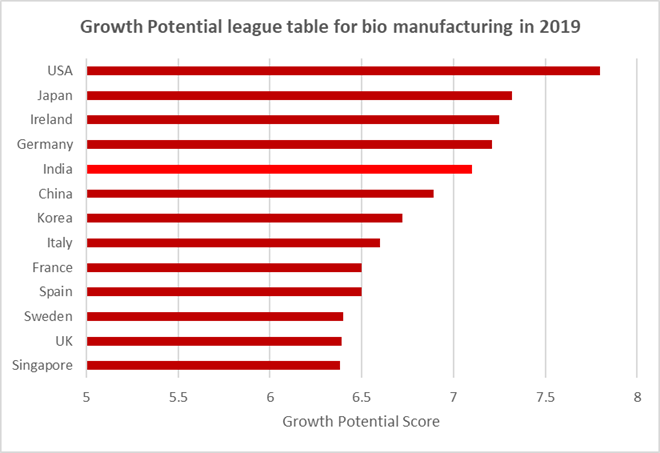
India predicted to be one of the world’s ‘fastest growing bio’ hubs in 2019, fuelled by new biosimilars production.
New data from CPHI shows that, despite ongoing reputational challenges, India’s biologics market is set for robust growth in 2019 driven by biosimilars production. The India-specific findings from CPHI’s bio league tables predict strong ‘bio growth potential’ in India throughout 2019 in the build-up to the 13th edition of CPHI India 2019, which will take place at the India Expo Centre in Delhi NCR.
However, highlighting the market’s ambivalent reputation, India also received the second lowest overall scores for ‘quality of biologics manufacturing’ and ‘biologics innovation’. Yet for ‘growth potential’ India (7.05) scored extremely highly, finishing broadly level with the well-established advanced bio markets Germany (7.2), Ireland (7.2) and Japan (7.3), and behind only the US (7.8) – but significantly, ahead of China (6.9) and its widely documented rapidly expanding bio sector.
India’s growing biosimilars industry is the primary driver of growth, with respondents citing ‘India’s rising domestic demand, bio investments and the potential for increased exports to advanced markets’. Already, India has over 70 approved biosimilars in the domestic market (more than any other country) and market penetration – which is currently relatively low – is expected to increase quickly in 2019 as the middle classes increase demand.
This growth potential is augmented by government subsidies for production of biosimilars, expiration of existing biologics patents and India’s Central Drugs Standard Control Organisation aligning guidelines closely with other regulators such as the US FDA. In fact, the Associated Chambers of Commerce of India 2017 report predicts that the biosimilars market in India was worth $2.2bn and is expected to reach an astonishing $40bn by 2030.
Cara Turner, Brand Director, Pharma, commented: “CPHI and P-MEC India have been extremely successful and we announced before the event that India had secured the number one spot for growth potential of small molecules in 2019. These new findings however, show that biosimilars are also set for dramatic growth in 2019 and that India is expected to be amongst the fastest growing bio regions. In fact, over the next few years we anticipate seeing more bio machinery manufacturers attending P-MEC and a steady growth in our bio audiences.”
Demand in Europe and the US is expected to sustain longer term growth rates as these markets open-up further to biosimilar encroachment and encourage new entrants. Undoubtedly, the lower cost of manufacturing in India makes biosimilars exports attractive to Western markets. Initial market entry may be slowed by high clinical development costs – which can be as much as $150million for an approval in the US. As a result, it is predicted that in 2019 we will see a greater number of Western-Indian partnerships (aka the Mylan-Biocon model) jointly bringing new biosimilars to patients in both the EU and US.
The research highlighted that unlike its small molecule industry – which improved rapidly in the 2018 league tables – the bio industry in India is still viewed by international pharma as substantially behind the leading markets in terms of quality and innovation. Notably, the top ranked nations of the US, Germany, and Japan, and the second tier of advanced nations, Sweden, Ireland, Switzerland, the UK, France and Korea.
The relatively low score for both quality (6.0) and innovation (6.0) is probably reflective of the lack of any patented biologic development in India, with the majority of this work being retained in Europe and the US. However, the nation did score intermediately for ‘knowledge of its bio professionals’ (6.6) and its ‘ability to meet future capacity requirements’ (6.7) – suggesting that there is more than adequate facilities built or under construction to meet rising future demand.
After the huge success of the 2018 event, CPHI & P-MEC India 2019 will be returning to the India Expo Centre in the nation’s capital for the second time and Rahul Deshpande, Group Director, UBM India added; “What is most exciting is that we’ll be returning to a single site event taking place in the nation’s capital Delhi, bringing together regulators, industry and international pharma in what will have been a record-breaking year for the pharma industry in India. ”
Related News
-
News Novartis signs US$3.2 bn subcutaneous delivery deal with Alteogen
Swiss pharma giant secures access to Korean biotech's ALT-B4 hyaluronidase platform in milestone-heavy agreement, marking Alteogen's fourth major licensing deal of 2026 as competition intensifies in the subcutaneous drug delivery space.
-

News Women in Pharma: The philosophy of pharmaceutical leadership
In this latest instalment of our Women in Pharma series, we sit down with Clarissa Sowemimo-Coker, Chief Strategy Officer at Ambrose Healthcare and CPHI Middle East Advisory Board Member.
-

News The PSCI Supplier Partnership - Collaboration for Responsible Supply Chains
About the Pharmaceutical Supply Chain Initiative The Pharmaceutical Supply Chain Initiative (PSCI) is the leading, member-led association for pharmaceutical companies working collaboratively to build responsible supply chains. Founded in 2006 and es... -

News AstraZeneca shares plunge 8.9% after reports of BMS talks
Britain's largest drugmaker lost more than GBP£17 billion in market value following reports of preliminary merger discussions with Bristol Myers Squibb that could create a pharmaceutical giant worth nearly US$400 billion, though investors rem... -
News GSK announces £400 million investment in new Cambridge R&D centre
Pharmaceutical giant to establish flagship research facility on Cambridge Biomedical Campus as part of strategic pipeline acceleration
-

News The CPHI Sustainability Summit - Where Conversation Becomes Collaboration
The Report Was Never the Destination - “The future of pharmaceutical sustainability won’t be shaped by individual organisations working in isolation. It will be shaped by partnerships, shared expertise and the willingness to work diffe... -

News Trump's generic drug tariffs set to reshape global pharmaceutical supply chains
The US president has announced plans to impose tariffs of up to 200% on imported generic medicines from August 2028, giving manufacturers a two-year window to establish domestic production facilities. The move threatens to upend a global supply chain t... -
News Building Safer, More Responsible Pharmaceutical Supply Chains: PSCI Global Audit Insights
The Pharmaceutical Supply Chain Initiative (PSCI) has released its seventh annual Audit Findings Analysis Report, offering unprecedented insights into supplier practices across the global pharmaceutical and healthcare industry.With a record-breaking 24...