
Bosch launches new WFI system at interpack
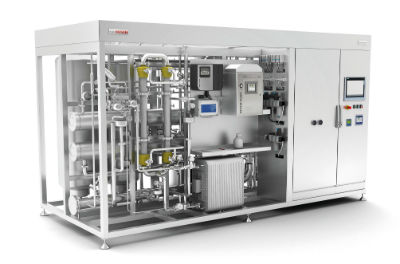
WFI production using membrane processes.
Efficient alternative to distillation.
At interpack 2017, Bosch will present its new system for the production of water for injection (WFI). As the name implies, first and foremost WFI is used in solutions for injection and infusion, making it a key component in pharmaceutical manufacturing. To date, it was only possible to produce WFI for the European market using distillation. However, as of 1 April 2017, the revised European Medicine Agency (EMA) Pharmacopeia allows, for the first time, WFI to be obtained using other comparable processes. “Our generation unit is specially designed to meet the EMA requirements,” explains Dr John Medina, Sales Manager at the Bosch subsidiary Pharmatec, which developed the unit.
WFI production using membrane processes
The generation unit employs the 'cold' membrane processing methods reverse osmosis and electrodeionization, together with an additional ultrafiltration step. Reverse osmosis is a physical filtration process that removes ions from the water, and the subsequent electrodeionization further reduces the remaining salt content through a combination of ion exchange and electrodialysis. The unit’s ultrafiltration module then separates out particles such as microbes and pyrogens on the basis of their weight and molecular size. Until now, in the European Union this method was only approved for the production of highly purified water (HPW), whereas in the US and Japan it has already been approved for obtaining WFI. In the future, the process will also be permitted by European authorities – albeit with additional, specific requirements.
Offering both thermal and chemical sanitization
Essentially, the unit must produce water under conditions that prevent the growth of micro-organisms and other impurities. For reverse osmosis systems, the EMA stipulates regular sanitization of the unit using hot water – primarily to prevent the formation of biofilms. Biofilms are caused by microbes, such as bacteria, and are difficult to remove from industrial systems. For additional protection, chemical sanitization must also be an option.
According to Medina: “The unit on display at interpack allows routine thermal sanitization. When it comes to hot water sanitization, temperatures of 85 degrees Celsius can be reached.” In addition, the EMA recommends chemical sanitization using ozone, to minimize the risk of microbial contamination. The unit offers this option as well. To prevent contamination as a result of insufficient barrier properties, the membranes’ integrity is checked on a regular basis.
Bosch has now reworked the WFI unit, including a more hygienic design and built-in measuring technology to monitor the system. The stainless steel used in the storage and distribution systems does not affect the water quality. Further, the system allows all the components to be thermally sanitized at any time.
Process monitoring is essential for water quality
“Monitoring all the processes in the production chain is essential to guaranteeing the microbial quality of the water,” says Medina, “which is why we fitted the unit with various sensors and measuring devices to monitor the water quality throughout the process and to check the individual steps.” Total organic carbon (TOC) is a key indicator of the water’s quality, and since it is also a parameter for the risk of microbial contamination in the overall system, it has to be continually monitored. Conductivity is another important parameter, and here the EMA stipulates inline process control. The unit is equipped with an online measuring system to monitor specific conductivity. To routinely test the water in real time, Bosch has also installed an online microbe counter, which continuously records and quantifies the level of microbes and inert particles using light-induced fluorescence measurements and algorithms. All parameters are centrally monitored and controlled by means of an intuitive interface.
Related News
-
News The PSCI Supplier Partnership - Collaboration for Responsible Supply Chains
About the Pharmaceutical Supply Chain Initiative The Pharmaceutical Supply Chain Initiative (PSCI) is the leading, member-led association for pharmaceutical companies working collaboratively to build responsible supply chains. Founded in 2006 and es... -

News CPHI Americas 2026 - From the Floor
Our From the Floor live blog returns to Philadelphia for CPHI Americas 2026, continuing to showcase the entire pharmaceutical supply chain from north to south across the Americas.
-

News DCAT Week 2026: Insights from Thermo Fisher Scientific
Anil Kane, PhD, MBA, serves as the Executive Director and Global Head of Technical & Scientific Affairs at Thermo Fisher Scientific, a global leader in scientific research and innovation. In this exclusive interview, Kane shares his and Thermo Fisher&#... -

News A Day in the Life of a CPHI Attendee
The series aims to highlight some of the indispensable talent involved in all aspects of the pharma value chain, getting to know the people working towards better healthcare across the world. This special edition aims to get to know the people attendin... -

News CPHI Pharma Awards 2026: Recognising Excellence in an Evolving Industry
Submissions now open — deadline May 16
-
News Packaging Under Pressure: Where Sustainability in Pharma Meets Reality
A Reflection on the Sustainability Collective Roundtable Session at Pharmapack 2026
-

News Where Pharma Innovation Takes the Spotlight: Pharmapack Awards 2026
The 2026 Pharmapack Awards, held January 21, 2026, celebrated and recognised leading companies in the pharmaceutical packaging sector paving the way for packaging and drug delivery excellence in the future.
-

News Pharmapack 2026 - From the Floor
Celebrating its 25th anniversary in the city where it all started, Pharmapack 2026 is back in Paris! From January 21-22, 2026, Paris Expo Porte de Versailles opens its doors again to the pharmaceutical packaging and drug delivery sectors, ready for 2 d...